Does dark skin limit winter vitamin D synthesis?
The advice circulates with the confidence of folk wisdom: darker-skinned individuals struggling with low vitamin D should simply spend more time outdoors. Push the exposure. Skip the sunscreen. Let the skin do what evolution supposedly optimized it to do.
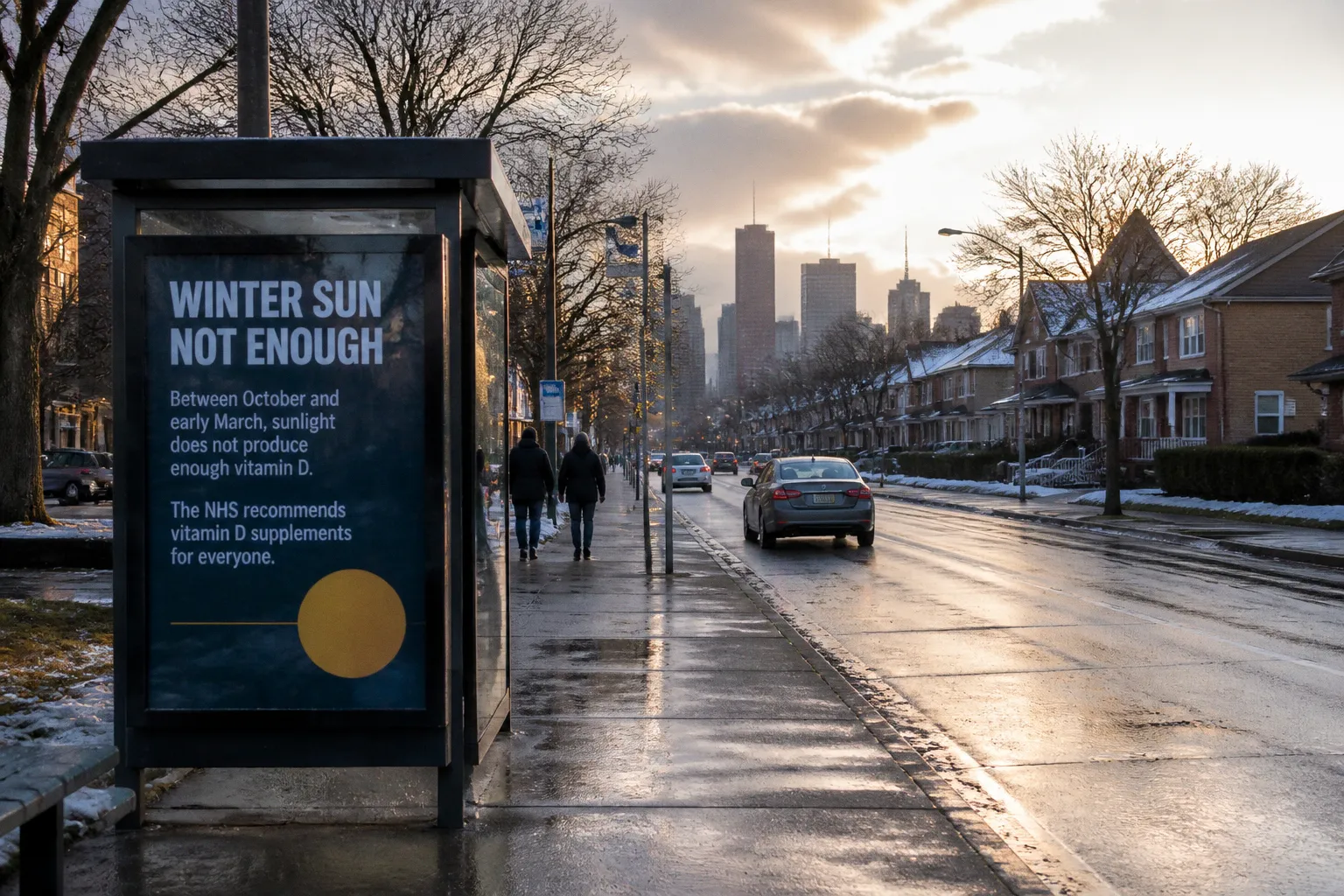
The Sunshine Paradox: Why "Just Get More Sun" Fails Darker Skin in Winter
The biochemistry — and, more damningly, the serum 25-hydroxyvitamin D data — refuses to cooperate with this narrative. At latitudes above roughly 40° north or below 40° south, winter sunlight delivers a midday UV index that drops below the threshold required for cutaneous previtamin D3 synthesis in any skin phototype. Melanin is not the limiting reagent during the vitamin D winter. The solar zenith angle is. The tragic consequence is that darker-skinned populations enter this season with already-depleted baseline stores from reduced summer synthesis, then face four to five months of unavoidable atmospheric blockade. The clinical signal is unambiguous: serum 25(OH)D concentrations in these populations collapse precisely when the popular advice suggests they should be climbing.
Popular framing blames the patient. The spectrophotometer blames the latitude.
The Photon War: Melanin as a UV Filter, Not a Vitamin D Blocker
To understand why this matters, one has to look at the molecular competition playing out in the epidermis. Cutaneous vitamin D synthesis is initiated when 7-dehydrocholesterol (7-DHC) in the skin absorbs a UVB photon in the 290–315 nm wavelength band and photoisomerizes into previtamin D3. Melanin — particularly eumelanin in darker phototypes — absorbs across the same UVB range. It is, in effect, a competing chromophore. Every photon melanin captures is a photon that cannot reach 7-DHC, and the higher the epidermal melanin concentration, the greater the per-photon loss.
This is not a defect. It is a photoprotective adaptation — nature's broad-spectrum sunscreen. But it has a measurable kinetic consequence. Estimates derived from controlled photolysis studies suggest that individuals with darker skin phototypes require outdoor exposure times ranging from 30 minutes up to 3 hours to generate the same vitamin D yield that a fair-skinned individual achieves in roughly 15 minutes under identical environmental conditions. The range reflects variation in phototype (Fitzpatrick III through VI), exposed body surface area, time of day, and altitude, but the directional finding holds: more melanin, more minutes required.
| Parameter | Fair skin (Fitzpatrick I–II) | Dark skin (Fitzpatrick V–VI) |
|---|---|---|
| Epidermal melanin density | Low | High |
| UVB photon competition with 7-DHC | Minimal | Substantial |
| Estimated exposure for equivalent D3 yield | ~15 minutes | 30 minutes to 3 hours |
| Summer cutaneous synthesis capacity | High | Reduced but functional |
| Winter cutaneous synthesis at >40° latitude | Negligible (zero UVB) | Negligible (zero UVB) |
The last row is the one the supplement industry prefers to omit from its marketing collateral. Because once winter arrives at mid-to-high latitudes, the epidermal melanin variable becomes mathematically irrelevant — there is simply no usable UVB to filter.
Latitude Eats the Photons First: Webb, Kline, and Holick's Uncomfortable Finding
The mechanistic reality of the "vitamin D winter" was nailed down in 1988 by Webb, Kline, and Holick, who demonstrated that at latitudes such as Boston (42°N) and Edmonton (53°N), solar zenith angles between November and February are steep enough that stratospheric ozone absorbs virtually all incoming UVB in the 290–315 nm action spectrum. No amount of melanin competition, phototype variation, or "ancestral sun exposure" rhetoric changes this. The photons simply never reach the ground in biologically relevant quantities.
The operational threshold is well defined: at latitudes greater than approximately ±40°, midday clear-sky UV index during winter months drops below 2 — the level below which practical sun exposure becomes ineffective for maintaining adequate vitamin D status regardless of pigmentation. This is not a hypothesis. It is a spectrophotometric measurement, repeated annually, at every meteorological station above the 40th parallel. The marketing claim that dark-skinned individuals can "boost their winter vitamin D with outdoor walks" is, at this latitude, a placebo delivered in cold air.
At 53°N in February, the atmosphere removes the variable. No skin type outruns ozone absorption.
The Baseline Cliff: Why Darker Skin Loses More Going Into Winter
Here is where the inequity sharpens. If winter synthesis were the entire story, every skin phototype would simply start the season with full summer stores and gradually drift down to a uniform deficiency by spring. The data does not support that symmetry. Darker-skinned populations enter winter with lower baseline 25(OH)D concentrations because summer synthesis was already running at reduced efficiency — those 30-minute-to-3-hour exposure requirements translate, in real-world behavior, into meaningfully lower annual UVB doses. People with fair skin who work indoors in summer still synthesize appreciable vitamin D from incidental exposure (commuting, walking, even brief midday breaks). People with dark skin performing the same behaviors may not.
The downstream serum picture is stark. In high-latitude countries with substantial darker-skinned populations — the United Kingdom, Canada, the United States, the Nordic nations — epidemiological studies consistently report higher prevalence of 25(OH)D < 20 ng/mL (50 nmol/L) in Black, South Asian, and Middle Eastern populations. Figures as high as 82% deficient status have been reported in cohorts of Black women in northern U.S. cities. This is not a marginal difference. It is a structural one, driven by the interaction of melanin filtration in summer and total UVB deprivation in winter.
The implication for public health is uncomfortable: simply recommending "more sun" to darker-skinned populations during the months when synthesis is actually feasible (April through September) would require either exposure durations or surface-area exposures that are socially and occupationally impractical for most people. And during the months when the advice is most often given — winter — it is biochemically inert.
Reexamining Exposure Strategy by Phototype
A serious look at the photobiology demands three distinctions.
1. Summer, mid-latitudes, all phototypes: Synthesis is possible. Fair skin achieves adequacy in minutes; dark skin needs substantially longer exposures or larger exposed body surface area. Between 10:00 and 15:00, with face, arms, and legs uncovered and unprotected, darker-skinned individuals can build meaningful stores — but the doses required are rarely met by incidental modern lifestyles. Diet and supplementation fill the gap.
2. Winter, mid-to-high latitudes (>40°): Synthesis is impossible for everyone. Melanin does not "worsen" the situation — it cannot, because the substrate photons are already removed by atmospheric filtration. Supplementation is the only evidence-based intervention.
3. Winter, equatorial and low latitudes (<35°): UVB remains sufficient year-round, and dark-skinned individuals can synthesize vitamin D with adequate exposure. This is the only climate context where the "get more sun" advice has biochemical validity.
The marketing literature frequently collapses these three categories into a single instruction — "sunlight is the natural solution" — which is a category error of the most consequential kind. It also reveals a recurring failure mode in nutritional communication: photobiology is geographically specific, but advice is distributed globally.
The advice is geographically portable. The mechanism is not.
The Evidence-Based Verdict on Winter Supplementation
Public health bodies operating at the latitudes where this matters most have converged on a remarkably consistent recommendation. The UK NHS, for example, advises that between October and early March the available sunlight does not produce sufficient vitamin D, and recommends a daily supplemental intake of 10 micrograms (400 IU) for adults across the population — not stratified by skin phototype, because the atmospheric constraint applies to everyone. The IOM's 2011 report established similar population reference intakes. These recommendations are not optional lifestyle suggestions; they are the operational answer to a spectrophotometric problem.
The clinical biochemistry is settled. Winter sun at >40° latitude is not a variable that can be modulated by behavior. It is a constant — zero. The only levers left are dietary intake (limited, because few foods are naturally rich in vitamin D or are consistently fortified at therapeutic levels), supplementation (effective, cheap, scalable), and, in select cases, lamps delivering UVB at action-spectrum wavelengths (impractical at population scale). Everything else is narrative.
Final Position
Dark skin does limit the rate of cutaneous vitamin D synthesis — this is unambiguous photochemistry. But in winter at mid-to-high latitudes, this limitation is irrelevant because the synthesis pathway is closed for all skin types. The real clinical burden falls on populations that combine higher melanin density with northern geography, because they enter the vitamin D winter with reduced baseline stores and exit it with the highest measured deficiency rates. The remedy is not more sun. It is 10 micrograms a day, from October to March, acknowledged as policy rather than marketed as optional wellness. The lab data has been saying this for over three decades. The supplement aisle has been ignoring it for just as long.