Vitamin D forms: which chemical path suits your trial?
In vitamin D research, the choice between cholecalciferol and calcifediol is not a minor formulation detail.
It determines how much of the metabolic pathway a trial is actually testing, how quickly serum 25-hydroxyvitamin D rises, and whether participants with different hepatic, nutritional, or adherence profiles can reach the study’s target range within the planned follow-up period.
That distinction matters because many trials describe their intervention simply as vitamin D supplementation, although vitamin D3 and calcifediol do not enter the body at the same point in the pathway. Cholecalciferol must undergo 25-hydroxylation in the liver before it becomes calcifediol, while calcifediol is delivered already converted at that position. For researchers choosing between calcifediol vs cholecalciferol clinical trial options, the central question is therefore not which compound is universally superior, but which biological step the protocol needs to preserve, accelerate, or deliberately bypass.
The metabolic divergence: where each form enters the pathway
Cholecalciferol, commonly known as vitamin D3, is the upstream form. It can be produced in the skin after ultraviolet exposure and is also used in oral supplements and fortified foods. Once absorbed, cholecalciferol must be converted in the liver through 25-hydroxylation to form 25-hydroxyvitamin D, or 25(OH)D, the principal circulating marker used to assess vitamin D status.
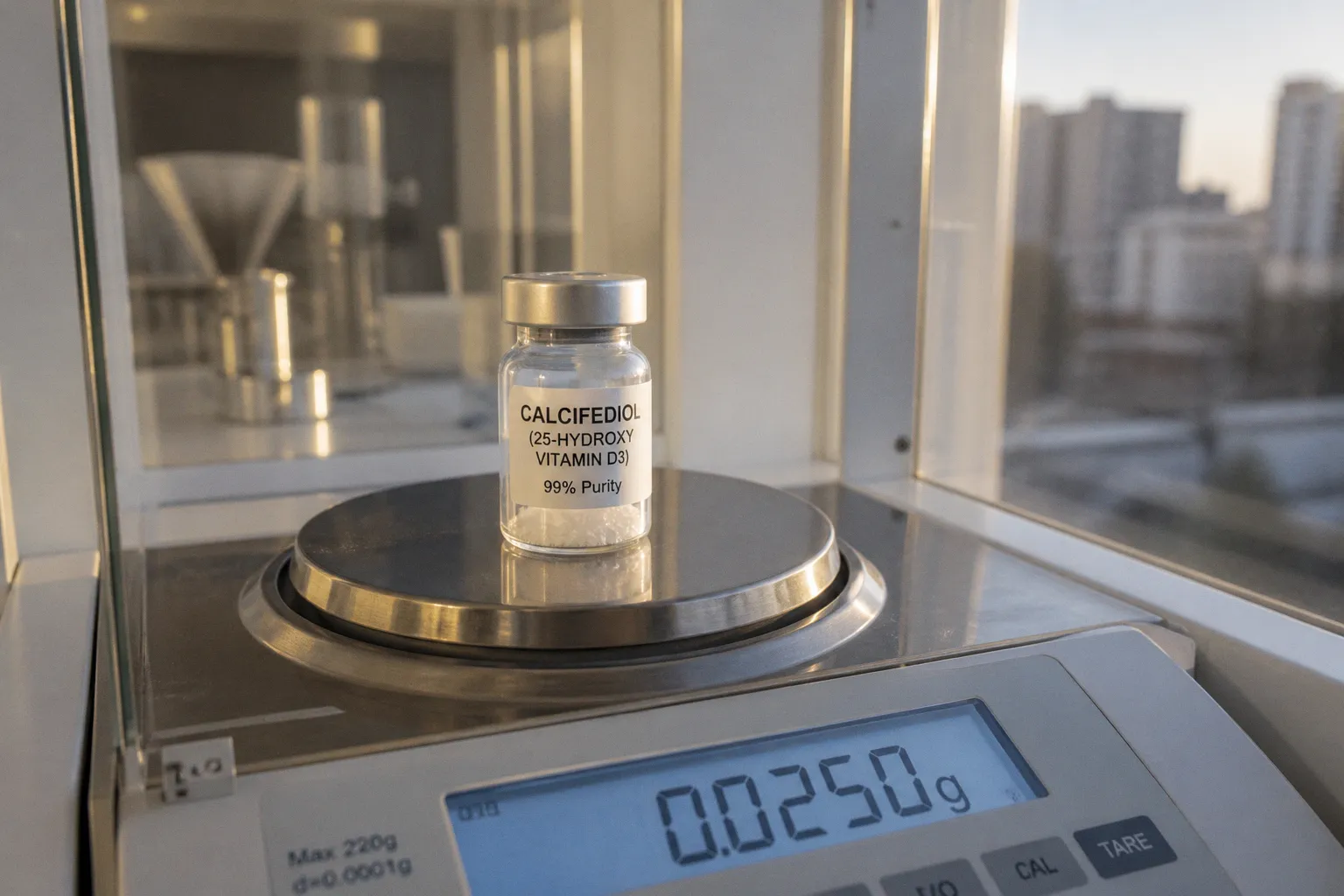
Calcifediol is 25-hydroxyvitamin D3. In practical trial design, it represents a more direct route to the serum metabolite researchers usually measure. It does not require the same hepatic carbon-25 hydroxylation step because that conversion has already taken place before administration.
This does not mean that calcifediol removes every biological uncertainty. The compound still has to be absorbed, transported, distributed, and metabolically regulated, and downstream vitamin D activity still depends on conversion to more active hormonal forms, tissue-level vitamin D receptor pathways, calcium availability, and the health characteristics of the participant population. What changes is the location of the intervention within the pathway.
That difference can be decisive in populations where the research question concerns the speed or reliability of serum 25(OH)D correction. It may be less decisive when the trial is designed to model ordinary food exposure, routine supplementation, or the physiological sequence that begins with cholecalciferol.
The choice is not simply between two vitamin D products; it is a choice about which metabolic bottleneck the trial will include.
Cholecalciferol: a familiar upstream intervention
Cholecalciferol remains the most familiar form in public health programs, clinical practice, dietary supplements, and food-fortification discussions. It is widely understood, comparatively easy to communicate, and closely aligned with the form of vitamin D generated in human skin.
For a trial examining vitamin D3 supplementation under conditions that resemble routine practice, cholecalciferol may offer the more representative intervention. It allows hepatic conversion to remain part of the response, which can be useful when investigators want to observe the full sequence from administered nutrient to circulating 25(OH)D.
That apparent simplicity, however, can conceal variation. The observed serum response reflects not only the administered dose but also the participant’s ability to absorb and process it, the starting level of 25(OH)D, body composition, adherence, and the time available for the concentration to accumulate. In a heterogeneous study population, two people receiving the same cholecalciferol regimen may not experience the same rise in serum 25(OH)D over the same period.
The form is therefore well suited to questions such as:
- How does a conventional vitamin D3 regimen change serum 25(OH)D over several months?
- What response can be expected from an intervention that resembles common supplementation practice?
- How does cholecalciferol perform when the study is evaluating broad population delivery rather than rapid biochemical correction?
- What happens when vitamin D is incorporated into a food or supplement strategy intended for routine use?
These questions are not less rigorous than pharmacokinetic questions; they are simply asking about a different layer of the system.
Calcifediol: a direct route to the circulating marker
Calcifediol is often selected when a trial requires a faster or more predictable increase in serum 25(OH)D. Because it bypasses hepatic 25-hydroxylation, it can produce a more rapid biochemical response than an equivalent-looking intervention with cholecalciferol. The quantities cannot be compared on a simple one-to-one basis, because calcifediol is estimated to be approximately three to five times more potent in raising serum 25(OH)D.
That potency changes both the scientific opportunity and the safety logic of a protocol. A dose that appears numerically small may have a substantial effect on the measured biomarker, while a cholecalciferol dose expressed in international units cannot simply be converted by arithmetic into an equivalent calcifediol dose. Investigators must treat the two compounds as pharmacologically distinct interventions, not interchangeable labels for the same exposure.
Calcifediol is particularly relevant when the trial includes participants with vitamin D deficiency and a short period for correction, or when the protocol requires a high proportion of participants to cross a predefined serum 25(OH)D threshold. It may also be informative in research involving conditions where hepatic conversion is suspected to be a limiting step, although the evidence base does not justify treating calcifediol as a universal solution for every form of impaired metabolism.
Pharmacokinetics: potency, half-life, and response velocity
The most visible contrast between the two forms appears in the trajectory of serum 25(OH)D. Calcifediol generally raises the marker more quickly, while cholecalciferol has a longer reported plasma half-life.
The available evidence describes an elimination half-life of approximately 25–30 days for cholecalciferol and approximately 10–15 days for calcifediol. This shorter half-life for calcifediol should not be mistaken for weaker performance. Its greater potency and more direct entry into the 25(OH)D pool mean that a shorter half-life can coexist with a faster and larger rise in the measured biomarker.
For trial teams, this creates a design tension. A rapid response can help researchers reach an endpoint sooner, reduce the time participants remain deficient, and improve the interpretability of an early pharmacodynamic outcome. At the same time, the intervention’s higher potency means that dose selection, administration frequency, and monitoring require more deliberate planning.
| Trial consideration | Cholecalciferol | Calcifediol |
|---|---|---|
| Position in the pathway | Requires hepatic 25-hydroxylation to form 25(OH)D | Already hydroxylated at carbon 25 |
| Relative effect on serum 25(OH)D | Slower and less potent at comparable study framing | Approximately 3 to 5 times more potent in raising 25(OH)D |
| Reported plasma half-life | Approximately 25–30 days | Approximately 10–15 days |
| Early biomarker response | More gradual accumulation | Faster elevation of serum 25(OH)D |
| Best alignment | Routine supplementation, food-based delivery, longer observation | Rapid correction, threshold attainment, pathway-focused pharmacokinetics |
| Dose interpretation | Often expressed in micrograms or international units | Must be treated as a distinct, more potent exposure |
| Main design caution | Response can vary with conversion and participant characteristics | Dosing schedules cannot be copied from cholecalciferol protocols |
In one 16-week clinical trial, participants receiving 20 micrograms per day of calcifediol were compared with participants receiving 60 micrograms per day, equivalent to 2,400 IU per day, of cholecalciferol. By four weeks, 87.5% of those in the calcifediol group had reached total serum 25(OH)D levels of at least 30 ng/mL, compared with 23.1% in the cholecalciferol group. The mean increase during the first month was also greater with calcifediol: 9.7 ± 6.7 ng/mL versus 5.1 ± 3.5 ng/mL with cholecalciferol.
These findings speak directly to response velocity, not to every clinical outcome that may follow from improved vitamin D status. A trial showing that one form raises 25(OH)D more efficiently has not automatically demonstrated a corresponding reduction in fractures, improved immune function, or superior long-term health. Serum response is a meaningful endpoint, but it remains a biomarker endpoint.
Threshold attainment: when speed changes the trial
The choice of vitamin D form becomes especially consequential when the study is built around a threshold, such as serum 25(OH)D above 30 ng/mL. Threshold-based designs are vulnerable to slow accumulation because participants who are improving biologically may still be classified as not having reached the endpoint at the scheduled measurement.
A randomized clinical trial in postmenopausal women with vitamin D deficiency illustrates this difference. After four months, 35.0% of participants receiving monthly calcifediol at 0.266 mg had serum 25(OH)D levels above 30 ng/mL, compared with 8.2% of those receiving monthly cholecalciferol at 25,000 IU. The difference was statistically significant, with a reported p-value below 0.0001.
For investigators, the result has several practical implications.
First, the follow-up window must match the intervention. A monthly cholecalciferol schedule may require more time before its full serum response is visible, while calcifediol may shift the same biomarker within the early weeks of the protocol. If the sampling schedule is too sparse, the trial can miss the shape of the response and capture only a partial picture.
Second, threshold attainment should not be treated as a neutral measure detached from baseline status. A participant beginning with profound deficiency has farther to travel than someone beginning near the target range. The form of vitamin D may alter the speed of that journey, but baseline concentration remains central to interpretation.
Third, a higher percentage of participants reaching the target does not, by itself, answer whether the threshold is the correct clinical or public health endpoint for the population under study. The threshold may be appropriate for one protocol and insufficient for another, depending on whether the primary concern is bone mineral density, rickets prevention, calcium absorption kinetics, osteoporosis prevention, or a broader health outcome.
A systematic review and meta-analysis of 17 studies involving 1,575 participants found that 12 intervention trials reported calcifediol as more efficacious than cholecalciferol in raising serum 25(OH)D, regardless of dosage or administration frequency. That pattern strengthens the case for calcifediol when the immediate research objective is biochemical repletion, while still leaving open the question of whether faster repletion produces better long-term clinical outcomes.
A faster rise in 25(OH)D can improve trial efficiency, but it should never be confused with proof of broader health benefit.
Matching the form to the research objective
The cleanest way to choose between the two compounds is to begin with the endpoint rather than the product. Researchers should decide whether the protocol is testing a delivery strategy, a metabolic step, a serum biomarker response, or a downstream clinical outcome, because the same form will not be equally informative for all four.
If the primary endpoint is serum 25(OH)D
Calcifediol is often the stronger candidate when the study needs a rapid elevation or a higher probability of crossing a prespecified concentration threshold within weeks. Its direct position in the pathway can reduce the delay associated with hepatic conversion and make early pharmacodynamic differences easier to detect.
Cholecalciferol may still be preferable when the study aims to characterize the slower response associated with conventional supplementation, especially if the intervention is intended to inform everyday practice or population-level vitamin D3 delivery.
If the trial models food fortification
Food fortification introduces a different set of constraints. The intervention must be stable in the food matrix, deliverable at a population scale, acceptable to consumers, and compatible with existing manufacturing and regulatory systems. Cholecalciferol has a strong practical identity in this space because it is already familiar as a fortification and supplementation form.
Calcifediol may have a role in specialized research, particularly where rapid improvement in vitamin D status is the central objective, but its greater potency means that fortification design cannot be approached as a direct substitution for vitamin D3. The concentration per serving, consumption pattern, margin for variation, and monitoring strategy all require separate evaluation.
This is where nutritional equity becomes more than a policy phrase. A formulation that works under tightly supervised conditions may perform differently in communities facing systemic barriers such as irregular access to fortified foods, limited healthcare contact, variable dietary patterns, or inconsistent supplement use. Grassroots implementation requires the intervention to survive ordinary conditions, not only controlled trial conditions.
If the population may have impaired hepatic conversion
Because cholecalciferol depends on hepatic 25-hydroxylation, calcifediol can be scientifically relevant when investigators are examining whether that step limits the response in a particular population. The bypass does not eliminate the need for careful clinical characterization, and it does not establish that every participant with liver disease will respond in the same way. The evidence remains incomplete regarding the exact relative bioavailability ratio in populations with severe hepatic dysfunction across diverse ethnic groups.
That uncertainty should appear in the protocol’s assumptions rather than being hidden in the discussion section. A trial can be designed to explore the question, but it should not present the answer as settled before the data exist.
If the study measures bone or other downstream outcomes
For outcomes such as bone mineral density, fracture risk, calcium absorption, or osteoporosis prevention, biochemical speed is only one part of the causal chain. Researchers must allow sufficient time for the downstream endpoint to change and should avoid treating a rapid increase in 25(OH)D as a surrogate for every clinically relevant effect.
The current evidence does not establish long-term differences in fracture risk directly comparing calcifediol and cholecalciferol. A protocol focused on skeletal outcomes should therefore distinguish clearly between what the intervention is expected to change quickly—serum 25(OH)D—and what may require months or years to evaluate.
The same caution applies to research on immune system modulation. A change in vitamin D status may be biologically meaningful, but it does not settle the question of whether one chemical form produces a superior immune outcome in a defined population.
The dose problem: why apparent equivalence can mislead
The most common design error in comparing vitamin D forms is to treat dose numbers as if they were a shared language. They are not.
Cholecalciferol may be expressed in micrograms or international units, while calcifediol may be administered in milligram quantities or other formulation-specific units. More importantly, the same numerical quantity does not imply the same biological exposure. Calcifediol is approximately three to five times more potent in raising serum 25(OH)D, according to the available evidence, and its schedules must be constructed accordingly.
This affects randomization, blinding, safety monitoring, and statistical power. If a team copies the administration frequency used in a cholecalciferol trial without accounting for calcifediol’s potency and faster response, the resulting comparison may be poorly balanced from the start. Participants may receive exposures that are not meaningfully equivalent, while the protocol gives the appearance of a fair head-to-head test.
A well-designed comparison should define equivalence in relation to the research question:
- equivalent daily exposure;
- equivalent expected change in serum 25(OH)D;
- equivalent proportion reaching a target threshold;
- equivalent correction of baseline deficiency; or
- equivalent downstream clinical effect.
Those are different hypotheses. A trial that does not state which one it is testing may produce a statistically clean result that remains difficult to interpret.
The measurement plan also deserves attention. Early sampling can capture calcifediol’s faster elevation, but it may underrepresent the eventual cholecalciferol response. Later sampling can provide a more balanced view of sustained status, although it may miss clinically relevant differences in the initial correction period. A useful design may therefore include both early and later 25(OH)D assessments rather than relying on a single final measurement.
Where ergocalciferol fits—and where it does not
Ergocalciferol, or vitamin D2, appears frequently in discussions of vitamin D supplementation and in some clinical trials, but it should not be folded casually into a calcifediol-versus-cholecalciferol comparison. It is a different chemical form with its own pharmacokinetic and biological questions.
If a protocol includes ergocalciferol, the comparison should state why. Is the purpose to evaluate a plant-associated or historically used vitamin D source, to compare fortification options, or to examine differences in serum response by form? The study should then define its biomarker methods and dosing logic explicitly, rather than assuming that all vitamin D compounds can be ranked on one potency scale.
For research teams choosing vitamin D forms, the practical lesson is straightforward: expand the comparison only when the additional form answers a real scientific or implementation question. More arms do not automatically create a more informative trial, particularly when the dosing, analytical, and follow-up requirements become difficult to keep aligned.
Evidence gaps that should shape the next generation of trials
The existing evidence is strongest for the question of how quickly and efficiently each form raises serum 25(OH)D. It is less definitive for long-term clinical outcomes and for the populations most affected by complex metabolic or structural conditions.
Several evidence gaps deserve priority.
Long-term skeletal outcomes
The current record does not establish direct long-term differences in fracture risk between calcifediol and cholecalciferol. Trials targeting bone health should therefore avoid presenting biomarker superiority as fracture prevention. They should be designed around clinically meaningful outcomes, adequate follow-up, and careful characterization of calcium intake, baseline bone status, and concurrent osteoporosis therapies.
Severe hepatic dysfunction
Calcifediol’s ability to bypass hepatic 25-hydroxylation makes it a compelling candidate for focused studies in populations with hepatic impairment, yet the exact relative bioavailability ratio across severe dysfunction and diverse ethnic groups remains uncertain. Such studies should not assume that bypassing one step produces a uniform response in every participant.
Population implementation
A compound can perform well in a controlled trial and still encounter obstacles in public health delivery. Adherence, access, cost, formulation stability, cultural acceptability, and the distribution of deficiency all influence whether an intervention improves nutritional equity. For fortification programs, these questions are inseparable from the chemistry.
Interpretation of serum 25(OH)D
Serum 25(OH)D remains a central marker, but its interpretation depends on assay quality, timing, baseline status, and the chosen threshold. A trial should report the trajectory rather than only the number of participants above a cutoff, because two interventions can produce similar final proportions while differing substantially in how quickly and consistently they correct deficiency.
A practical route for investigators
For teams making a protocol decision, the following sequence keeps the chemistry connected to the public health question:
1. Define the endpoint before selecting the form. If the primary goal is rapid serum 25(OH)D correction, calcifediol deserves serious consideration; if the goal is to model conventional supplementation or food delivery, cholecalciferol may be the more relevant intervention.
2. Map the metabolic step under study. Cholecalciferol includes hepatic 25-hydroxylation in the intervention pathway, while calcifediol bypasses it. That distinction should be visible in the hypothesis, not left as a technical footnote.
3. Build dosing around biological potency, not label familiarity. Calcifediol and cholecalciferol do not require identical quantities or interchangeable schedules.
4. Schedule measurements to capture both speed and durability. Early sampling is essential when response velocity matters, while later follow-up is needed to understand sustained serum status and downstream outcomes.
5. Separate biomarker success from clinical success. Reaching a 25(OH)D threshold is an important trial result, but it does not independently prove improved fracture outcomes, immune function, or population health.
6. Test implementation conditions honestly. If the ultimate objective is nutritional equity, the study must account for the systemic barriers that determine who receives, uses, and benefits from the intervention.
The choice between these forms should ultimately serve the population and the question, not the convenience of a familiar protocol. Calcifediol offers a faster, more direct route to serum 25(OH)D and has repeatedly shown greater efficacy for raising that marker in the available comparative evidence. Cholecalciferol remains essential when the research objective is conventional vitamin D3 exposure, routine supplementation, or scalable fortification that reflects established public health practice.
The next step is not to declare a winner. It is to design trials that stop treating vitamin D status as a single undifferentiated outcome, distinguish metabolic correction from clinical benefit, and align chemical form, dose, timing, and delivery system with the realities of the communities the intervention is meant to reach. That is how vitamin D research moves from a cleaner laboratory comparison toward nutritional policy that is faster where speed is needed, representative where routine delivery matters, and fair enough to work beyond the trial site.