Hot vs cold extrusion for vitamin D rice stability
Vitamin D fortification can fail long before a fortified rice kernel reaches the household pot.
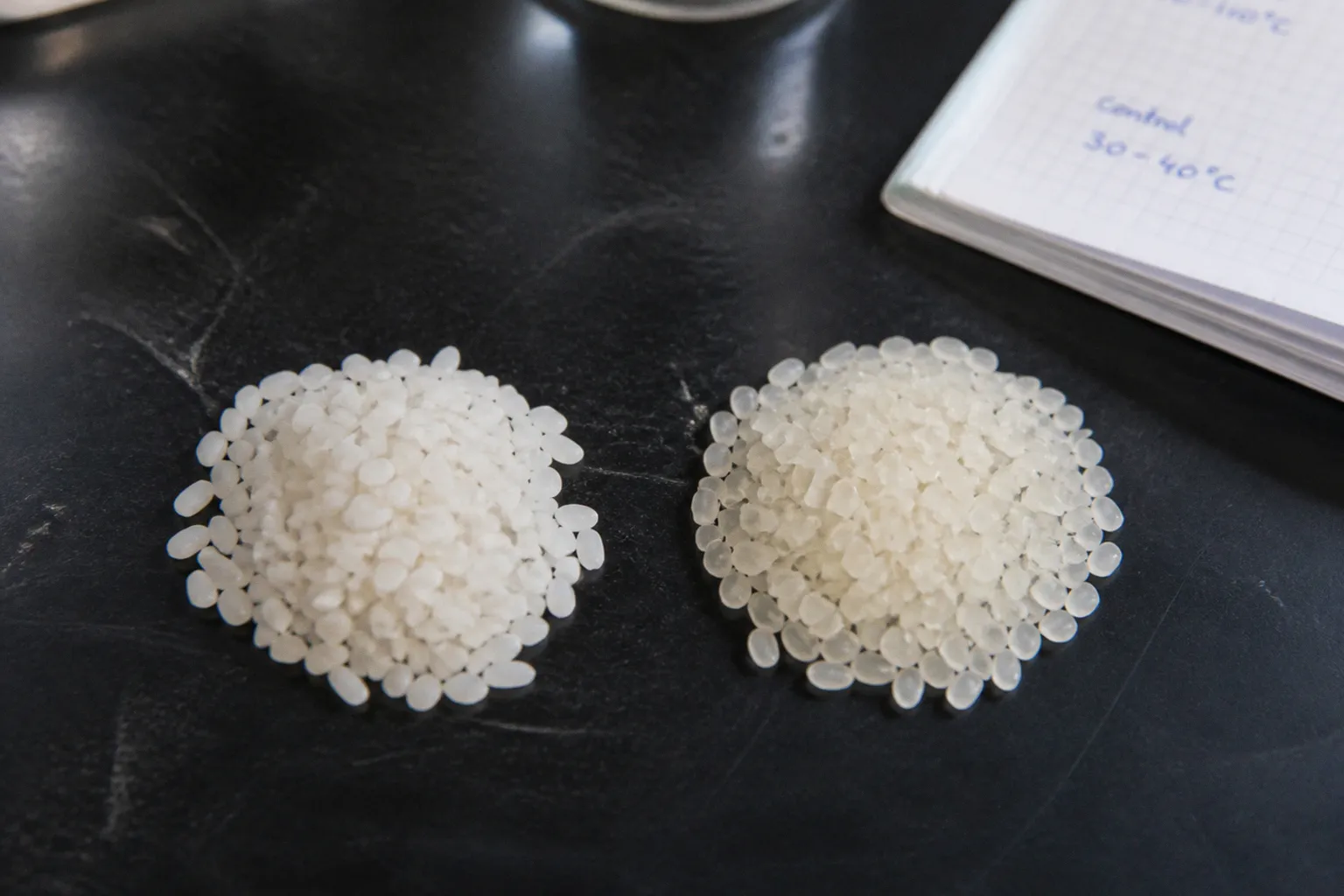
The difficulty is not simply adding vitamin D to rice flour, but protecting a fat-soluble, heat-sensitive nutrient through extrusion, drying, storage, washing, and cooking, while still producing a kernel that looks and behaves like ordinary rice.
That makes the comparison between hot extrusion and cold extrusion more consequential than a simple temperature choice. Hot extrusion can create a dense, gelatinized starch matrix that protects nutrients during domestic preparation, while cold extrusion limits thermal exposure but produces an uncooked, opaque kernel with a less protective internal structure. The better route depends on what happens after the extruder: whether vitamin D is free or protected, whether the kernel will be washed, how it will be cooked, and whether the product must withstand storage in warm, oxygen-rich conditions.
For anyone assessing hot extrusion vs cold extrusion vitamin D rice, the central question is therefore not which process uses less heat. It is which combination of process temperature, carrier matrix, kernel structure, and handling conditions delivers the intended vitamin D dose at the point of consumption.
Thermal dynamics: how barrel temperature shapes the kernel
Extrusion is both a cooking process and a forming process. The barrel temperature, screw configuration, moisture level, mechanical shear, and residence time collectively determine how rice flour behaves as it moves through the equipment. Those conditions also determine whether the resulting kernel is pre-cooked and translucent or raw and opaque.
Hot extrusion of fortified rice generally operates between 70 °C and 110 °C. Single- or twin-screw extruders can process broken rice flour into fully or partially pre-cooked simulated kernels, and the combination of heat, moisture, pressure, and shear promotes starch gelatinization. The result is a kernel with greater translucency and a texture closer to natural rice after cooking.
Cold extrusion operates below 70 °C, commonly around 30–40 °C. It is primarily a low-temperature forming process rather than a cooking step. The resulting kernels remain uncooked and are typically opaque. That lower thermal load may appear immediately attractive for vitamin D, particularly when the formulation contains an unprotected nutrient, but temperature is only one part of the stability equation.
The raw material also matters. Extruded fortified rice commonly uses broken rice milled to approximately 60–80 mesh, equivalent to roughly 177–250 microns, with flour moisture around 13–14%. Particle size and moisture influence how evenly the flour feeds into the extruder, how the matrix forms, and how consistently vitamin D is distributed across the batch. A process that protects vitamin D chemically but produces irregular kernels, surface enrichment, or poor mixing still creates a weak fortification system.
A simplified comparison is useful, provided it does not turn into a false hierarchy:
| Parameter | Hot extrusion | Cold extrusion |
|---|---|---|
| Typical barrel temperature | 70–110 °C | Below 70 °C, commonly 30–40 °C |
| Main process function | Forming plus partial or complete pre-cooking | Low-temperature forming |
| Kernel appearance | More translucent, closer to cooked rice in appearance | Usually opaque |
| Starch structure | Gelatinized or partially gelatinized | Largely ungelatinized |
| Potential advantage | Stronger matrix and better resistance to washing and cooking losses | Lower exposure to thermal stress |
| Main vitamin D concern | Heat, oxygen, and shear can degrade unprotected vitamin D | Weaker matrix may permit greater nutrient loss during preparation |
| Dependence on formulation | High, especially for protected vitamin D delivery | High, particularly because carrier selection affects retention |
The table points to the practical conclusion: neither method can be evaluated independently of the nutrient delivery system. A cold-extruded kernel with free vitamin D is not automatically more protective than a hot-extruded kernel containing encapsulated vitamin D3. Conversely, hot extrusion does not guarantee adequate retention merely because the finished kernel looks more like conventional rice.
Lower temperature reduces one source of stress; it does not, by itself, solve the problem of nutrient delivery.
The stability paradox: vitamin D in a high-heat process
Vitamin D is a lipid-soluble vitamin and is generally considered relatively stable compared with some other micronutrients during food processing. That relative stability should not be confused with immunity. High temperature, oxygen exposure, mechanical shear, and contact with reactive components of the food matrix can all contribute to degradation, particularly when the vitamin is present in a free and unprotected form.
In hot extrusion, vitamin D encounters several conditions at once. The barrel temperature may reach 70–110 °C, the material is subjected to mechanical energy, and the matrix is transformed under pressure and moisture. The nutrient may be exposed to oxygen before it becomes embedded within the finished structure, and the amount of protection depends on how quickly and uniformly the carrier system incorporates it.
Yet the same process that creates thermal stress can also create a protective architecture. Starch gelatinization changes the physical structure of the rice matrix, allowing micronutrients to become more firmly associated with the kernel rather than remaining concentrated on the surface. This is why hot-extruded rice kernels can show better resistance to nutrient loss during washing and cooking than less-processed kernels.
The apparent contradiction is important:
- Heat can reduce vitamin D retention when the nutrient is unprotected.
- Heat can also produce a gelatinized matrix that limits nutrient migration during later preparation.
- The final outcome depends on the balance between degradation during extrusion and protection after the kernel has formed.
This is the stability paradox at the centre of vitamin D retention in extruded rice. If evaluation stops at the barrel, hot extrusion may look unnecessarily harsh. If evaluation includes washing, cooking, and storage, the denser starch matrix may become a meaningful advantage.
Cold extrusion removes much of the direct thermal burden, but it does not necessarily produce a more secure nutrient system. Because the kernel remains uncooked and the starch is not gelatinized to the same degree, vitamin D can be more vulnerable to movement into cooking or washing water, especially if it is located near the surface or carried in a matrix that does not bind effectively to the rice structure.
This is also why a claim such as cold extrusion is always superior for vitamin D retention would be misleading. The process temperature alone cannot predict the dose that remains available at consumption. A meaningful comparison must measure retention after extrusion, after storage, and after the household preparation steps expected for the product.
Matrix engineering: why gelatinization matters
The rice kernel is not merely a visual shell around a vitamin premix. It is a delivery matrix, and its internal structure determines how the nutrient behaves when the product is handled by the consumer.
During hot extrusion, starch gelatinization alters the rice flour matrix. Under the combined influence of heat, moisture, pressure, and shear, starch granules lose their original organization and form a more continuous structure. In a fortified kernel, this transformation can help distribute and bind micronutrients within the body of the kernel.
That internal binding matters because fortified rice is commonly washed and cooked before it is eaten. If vitamin D is concentrated at the surface, loosely associated with the flour, or carried in a material that readily disperses in water, the apparent fortification level at production may not reflect the level delivered on the plate. The kernel can meet a manufacturing specification and still provide a less predictable dose after domestic preparation.
Hot-extruded kernels offer a structural response to that problem. Their gelatinized starch matrix can make the kernel more resistant to nutrient loss during washing and cooking, particularly when the nutrient has also been protected through encapsulation or impregnation. The process is not a substitute for formulation, but it can reinforce the formulation.
Cold-extruded kernels present a different design challenge. Their lower processing temperature protects the material from intense thermal exposure and preserves an uncooked, opaque structure. That may be useful when a formulation contains especially thermolabile compounds or when equipment and energy constraints limit thermal processing. But the absence of substantial gelatinization means the kernel may offer less resistance to nutrient migration during preparation.
For product developers, the relevant question is not whether the kernel is translucent or opaque as a matter of appearance. It is whether the matrix maintains nutrient distribution through the specific preparation pathway used by the target population. That pathway may include rinsing, soaking, boiling, draining, or repeated handling, and each step creates a potential point of loss.
A practical matrix assessment should therefore examine:
- How evenly vitamin D is distributed through the kernel rather than deposited primarily on its surface.
- Whether the nutrient remains associated with the rice matrix during washing.
- How the kernel behaves during boiling and whether the cooking water is retained or discarded.
- Whether the kernel survives transport and handling without producing vitamin-rich fines or powder.
- Whether the matrix remains stable during storage, particularly in warm and humid environments.
- Whether the finished kernel is visually and texturally acceptable enough to be used consistently.
These are not separate technical details. They form a chain. Poor particle uniformity can produce uneven extrusion; uneven extrusion can create irregular matrix formation; irregular matrix formation can increase surface exposure; and surface exposure can undermine vitamin D retention during storage or cooking.
Microencapsulation as a buffer against extrusion stress
The most important distinction in the hot-versus-cold comparison may not be temperature at all. It may be whether vitamin D3 enters the process as a free nutrient or inside a protective carrier.
Microencapsulation and carrier impregnation are designed to place vitamin D within a physical environment that reduces direct exposure to heat, oxygen, shear, and moisture. The carrier can also influence how the vitamin disperses through the rice flour and how firmly it remains associated with the finished kernel.
The available comparison is substantial. In cooking extrusion involving pea protein, retention increased from 45.4% for free vitamin D3 to 91.6% when vitamin D3 was impregnated into brewer’s spent yeast. This is not a minor adjustment at the edge of the formulation; it demonstrates that the carrier system can change the outcome of the same broad processing route.
The storage results reinforce the point. In fortified extruded products containing vitamin D3 impregnated into brewer’s spent yeast, retention remained at 85.1% after one month, compared with 38.9% for the non-encapsulated form. The carrier therefore provided protection not only during extrusion but also during the period after production, when oxygen, temperature, light, and moisture can continue to affect nutrient stability.
These figures should not be treated as universal values for every rice formulation. They describe a specific protective approach and a defined product context, not a guarantee that any encapsulated vitamin D3 will retain the same percentage under all processing or storage conditions. They do, however, establish a direction for industrial design: a protected vitamin D system can allow manufacturers to use a process that creates a stronger food matrix without accepting the full degradation risk associated with free vitamin D3.
The carrier itself must be selected with the food vehicle in mind. Brewer’s spent yeast, protein systems, lipid-based carriers, and other encapsulation materials can differ in particle size, dispersibility, oxidation behaviour, compatibility with rice flour, and effect on taste, colour, and kernel appearance. A carrier that protects the nutrient but produces poor mixing or unacceptable sensory changes may fail at the implementation stage.
This is where nutritional equity enters the engineering discussion. A technically impressive kernel that requires tightly controlled storage, specialized cooking, or unfamiliar preparation may not perform well in the communities it is intended to serve. Grassroots implementation depends on a product that survives ordinary distribution and ordinary kitchens, not only controlled laboratory conditions.
Encapsulation is not a decorative add-on to fortification; it is often the bridge between a nutrient that survives production and a nutrient that survives the food system.
Hot and cold extrusion in the real preparation chain
A rice fortification process should be judged across the full route from raw material to consumption. Looking only at extrusion retention risks confusing an intermediate measurement with the public health outcome.
Hot extrusion may impose greater initial thermal stress, but it produces a pre-cooked or partially pre-cooked kernel with a more developed starch matrix. That structure can reduce nutrient loss during washing and cooking. Cold extrusion may protect free vitamin D from the barrel temperature, yet its uncooked and less gelatinized kernel can leave the nutrient more exposed during preparation.
The comparison becomes clearer when the process is viewed through the main loss points:
1. Before extrusion: Vitamin D may be unevenly distributed in the premix or inadequately dispersed through the rice flour. A technically sound extruder cannot correct poor premixing.
2. During extrusion: Heat, oxygen, residence time, and shear can reduce retention, particularly for free vitamin D3. The effect is moderated by the carrier and by the way the nutrient enters the matrix.
3. During kernel formation and drying: Surface cracks, fines, or uneven moisture can increase exposure to oxygen and create non-uniform nutrient distribution.
4. During storage: Vitamin D retention can decline even when the extrusion step was well controlled. Packaging, humidity, temperature, and oxygen exposure become part of the fortification technology.
5. During washing and cooking: The kernel structure determines how much vitamin D remains associated with the rice and how much can move into discarded water.
6. At consumption: The delivered dose depends on actual household practices, not only on the labelled or calculated dose at manufacture.
This chain explains why a product specification should include more than vitamin D concentration immediately after extrusion. It should define the points at which retention is measured and the preparation method used for the final assessment. Otherwise, comparisons between hot and cold systems may reward the process that performs well in the factory while overlooking the process that performs better in the kitchen.
The distinction is especially important in settings where systemic barriers affect food access, storage, and preparation. A fortified rice product may move through long distribution routes, remain in warm warehouses, or be cooked with limited fuel and water. Under those conditions, a formulation that depends on ideal handling may produce a gap between intended fortification and actual nutritional exposure.
Choosing the process: a decision shaped by the food vehicle
There is no single extrusion method that should be prescribed for every vitamin D rice programme. The choice should follow the intended food vehicle, the available manufacturing infrastructure, the expected storage environment, and the preparation habits of the population receiving the product.
Hot extrusion is often the stronger candidate when the programme needs:
- A kernel that resembles natural rice in appearance.
- Partial or complete pre-cooking during manufacture.
- A gelatinized starch matrix with stronger resistance to washing and cooking losses.
- A delivery system designed to keep vitamin D distributed within the kernel.
- Compatibility with a protected vitamin D3 formulation that can withstand the thermal step.
Cold extrusion may be considered when the product design prioritizes:
- Lower processing temperatures, commonly around 30–40 °C.
- Reduced direct thermal exposure for sensitive ingredients.
- Equipment or production conditions that favour low-temperature forming.
- A raw, opaque kernel that will be cooked fully by the consumer.
- A formulation and preparation pathway capable of compensating for the weaker starch matrix.
Neither list is a verdict. It is a route map. The cold process may reduce thermal stress but require greater attention to surface distribution, washing losses, and carrier performance. The hot process may provide a stronger kernel but demand careful control of temperature, residence time, oxygen exposure, and nutrient protection.
A warm extrusion range, around 60–80 °C, can also appear in process development as an intermediate approach, but the available evidence does not support treating it as a universal compromise. Moving between process ranges changes the balance of gelatinization, thermal exposure, kernel texture, and nutrient stability; the result must be measured in the specific formulation rather than inferred from the temperature label.
What should be compared in a development trial?
A meaningful comparison of rice fortification extrusion methods should measure the same formulation under equivalent conditions. At minimum, the development team should compare:
- Vitamin D3 retention immediately after extrusion.
- Retention after the intended storage period, with temperature and packaging recorded.
- Distribution of vitamin D across whole kernels and fines.
- Retention after the expected washing and cooking procedure.
- Kernel appearance, breakage, opacity or translucency, and cooking behaviour.
- Moisture content and physical stability during handling.
- Performance of free versus encapsulated or carrier-impregnated vitamin D3.
- Any effect of the carrier on taste, colour, odour, or consumer acceptance.
The order matters. If only the post-extrusion value is measured, the team may select a process that produces a strong laboratory result but a weaker household result. If only storage is measured, preparation losses may remain invisible. If only chemical retention is measured, the project may miss the implementation barriers that determine whether fortified kernels are used correctly and consistently.
Why the carrier and the kernel must be designed together
Food fortification is often divided into separate tasks: one group selects the nutrient, another selects the carrier, and a third optimizes the extruder. In practice, these decisions are inseparable.
A vitamin D3 carrier affects how the nutrient disperses in rice flour, how it responds to heat and shear, and where it ends up in the finished kernel. The extrusion process affects whether the carrier remains intact, becomes incorporated into the starch matrix, or migrates toward the surface. The kernel structure affects what happens during cooking. Storage then tests the entire system under conditions that may be less forgiving than the factory environment.
This is why the strongest designs treat the kernel as a complete nutrient delivery platform rather than as a neutral container. The question is not simply whether vitamin D can be added to rice. It is whether the product can deliver a reasonably predictable amount through the chain of manufacture, distribution, preparation, and consumption.
The distinction has policy consequences. National fortification programmes need standards that reflect real retention rather than theoretical addition. Procurement specifications should describe the acceptable form of vitamin D, the required stability testing, and the conditions under which performance is assessed. Quality control should not end when the kernels leave the extruder, because the most consequential losses may occur later.
For researchers, this also means reporting process variables in enough detail to make comparisons meaningful. Temperature range alone is insufficient. The formulation, moisture, particle size, carrier system, extrusion configuration, storage conditions, and cooking method all influence the result. Without those details, hot and cold extrusion can appear to be competing technologies when they are actually different combinations of process and matrix design.
The public health implication: retention is only useful if access is reliable
Vitamin D fortification is ultimately a nutritional equity intervention. Its purpose is not to produce an impressive kernel in a controlled facility; it is to reduce preventable deficiency across populations that may face barriers to supplements, clinical monitoring, dietary diversity, or regular access to naturally vitamin D-rich foods.
That public health objective changes how technical trade-offs should be judged. A marginal gain in laboratory retention may matter less than a stable product that can be manufactured locally, distributed through existing food channels, and prepared without requiring households to change established routines. At the same time, a familiar product with poor post-cooking retention cannot be defended solely because it is easy to distribute.
The most credible route is a systems approach:
1. Define the vitamin D dose that needs to reach consumers, not merely the amount added during production.
2. Select a carrier that protects vitamin D3 through extrusion and storage while remaining compatible with the rice matrix.
3. Choose hot or cold extrusion according to the required kernel structure and the likely preparation pathway.
4. Test retention after washing and cooking, including any discarded cooking water.
5. Evaluate storage under the conditions the product will actually encounter.
6. Build quality control into procurement and distribution rather than treating it as a factory-only responsibility.
7. Use community feedback to identify practical barriers that laboratory protocols do not reveal.
This approach is deliberately cautious, but it is not pessimistic. The available evidence shows that vitamin D retention can be substantially improved through carrier impregnation and microencapsulation, and that the gelatinized structure of hot-extruded kernels can help protect nutrients during domestic preparation. Those are useful tools, provided they are integrated into a broader programme rather than presented as isolated technical fixes.
A practical position on hot versus cold extrusion
Hot extrusion is not automatically the enemy of vitamin D stability, and cold extrusion is not automatically its solution. Hot processing between 70 °C and 110 °C can expose unprotected vitamin D3 to thermal and mechanical stress, but it can also create a translucent, partially or fully pre-cooked kernel with a gelatinized starch matrix that resists nutrient loss during washing and cooking. Cold processing, commonly at 30–40 °C, reduces direct heat exposure, yet its uncooked and opaque kernels may provide less structural protection during household preparation.
The most defensible comparison is therefore conditional:
- Hot extrusion plus free vitamin D3 creates a clear risk of avoidable retention losses.
- Hot extrusion plus an effective carrier or encapsulation system can combine strong kernel structure with high vitamin D protection.
- Cold extrusion plus free vitamin D3 may limit thermal degradation but remains vulnerable to losses during washing, cooking, and storage.
- Cold extrusion plus a protective carrier may perform well, but the product still requires direct testing because the ungelatinized matrix changes how the nutrient behaves in the kitchen.
For researchers and policymakers, the next step is not to choose a process by temperature range alone. It is to establish a retention profile across the complete food system, with the same analytical discipline applied to extrusion, storage, and preparation.
The public health value of fortified rice will be determined at that final point of delivery. We should design for the nutrient that remains available to people, not the nutrient that was present when the kernel first left the machine. That means pairing appropriate extrusion technology with protective vitamin D systems, realistic storage and cooking trials, and grassroots implementation that recognises how food is actually handled. Only then can food enrichment technology move from promising formulation to dependable nutritional equity.