Vitamin D oil fortification: pre-production checklist
The marketing pitch for vitamin D oil fortification begins with a cleanroom, a high-pressure homogenizer, and a six-figure dosing skid. The biochemistry begins with a fat-soluble molecule dissolving into a warm lipid matrix.
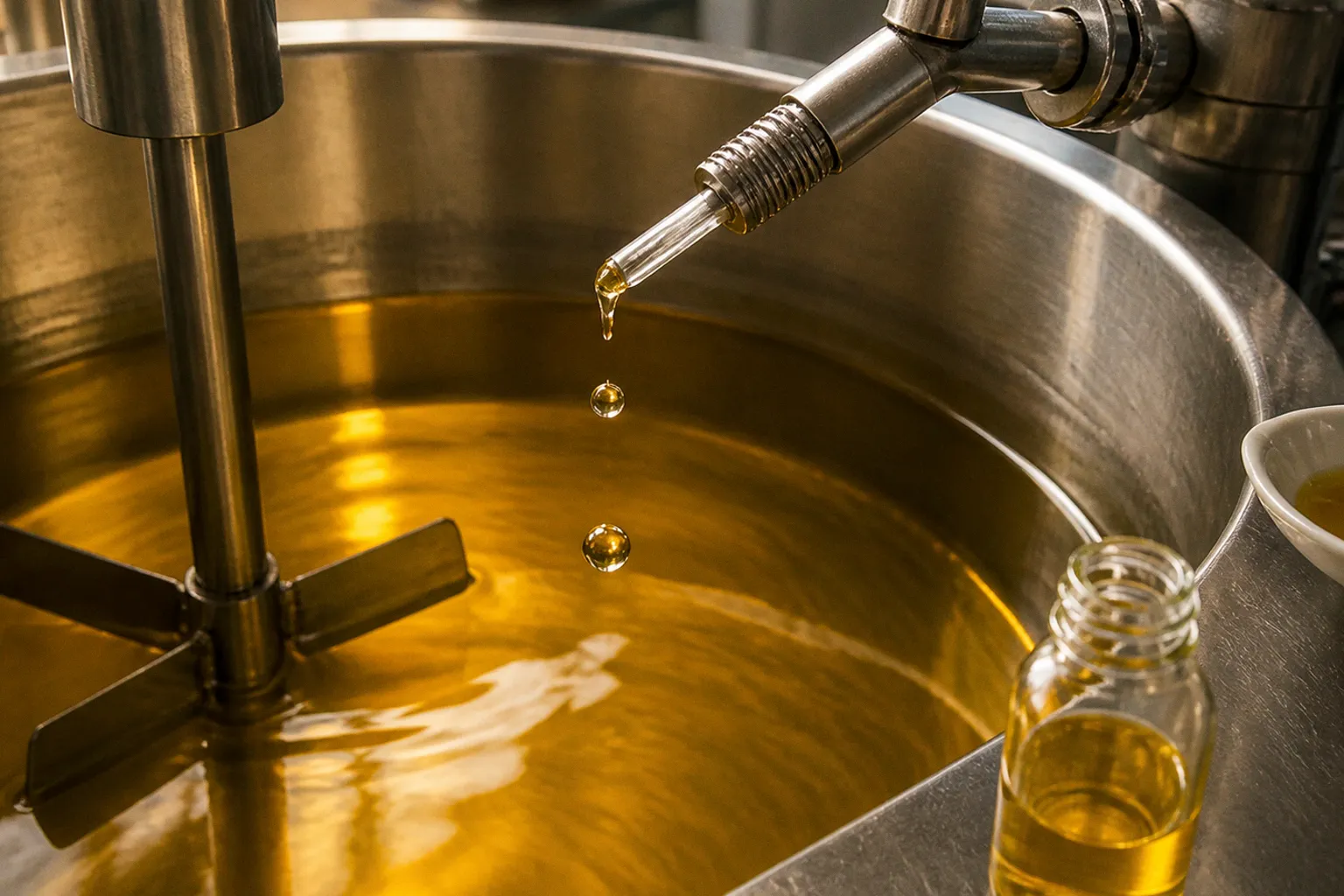
Those two opening lines produce two very different pre-production checklists — and two very different finished products, once the serum 25(OH)D measurements come back six months later.
The molecule is not usually the bottleneck. Degradation chemistry, the destination-specific regulatory ceiling, and HPLC confirmation on every batch are the bottlenecks. Everything else is equipment-vendor theater unless the product contains an emulsion, an aqueous phase, or another genuinely difficult delivery system.
What follows is what a clinical biochemist actually locks down before a single liter of fortified oil leaves the pilot line: the chemistry of vitamin-form selection, the engineering of the blend, the degradation pathways that can quietly reduce a delivered dose, the regulatory map that is emphatically not harmonized globally, and the QC protocols that catch failures before they reach a population study.
Selecting vitamin D forms and premix ratios for lipid matrices
Start where the marketing copy does not: the chemical form. Fortification programs that specify which vitamin D they are using often select cholecalciferol, or vitamin D3, rather than ergocalciferol, or vitamin D2. The reason is mechanistic rather than sentimental. D3 generally raises serum 25(OH)D more effectively per microgram than D2, reflecting differences in binding to vitamin D binding protein and in downstream metabolism. If the objective is to move a population-level serum curve, D3 is the rational default for an oil-based vehicle.
D2 still has a legitimate niche. It may be selected for vegetarian-certified products, fungal-source formulations, or markets where the ingredient specification already requires it. But that choice should be deliberate and documented. It should not survive merely because a previous SKU used D2 and nobody revisited the decision when the vehicle, target population, or regulatory market changed.
The next decision is physical form. Vitamin D for oil fortification arrives either as an oil-soluble liquid concentrate — the active already dissolved in a vegetable-oil carrier — or as a dry powder premix. For a pure lipid matrix, the liquid concentrate is usually the practical workhorse. It avoids an unnecessary aqueous phase and reduces the need for emulsifiers or surfactants that may interact with downstream refining, filtration, packaging, or sensory quality.
Dry powder forms are useful in water-based systems such as milk or flour, and in products where a free-flowing ingredient is operationally important. In straight edible oil, however, a powder can add a problem without solving one. The formulator must establish how the particles wet, disperse, and remain uniformly distributed before the oil reaches the final package. A dry ingredient that looks convenient in the weighing room can become a homogeneity problem in the production tank.
The pre-production step most facilities get sloppy with is the master-batch dilution. A widely used practice is to pre-mix the concentrated D3 source with warm oil at a ratio around 1:5 before adding the working premix to the main batch. This intermediate dilution gives the formulator a workable volume and improves distribution through the bulk tank. The ratio is not a universal law; it is a starting point that must be confirmed against concentrate viscosity, pumpability, tank geometry, and assay results.
Skipping the intermediate dilution and dumping a viscous concentrate straight into a large oil batch is the classic route to a potency-passes-but-homogeneity-fails outcome. The average assay may look acceptable while bottle-to-bottle variation within one batch remains unacceptable. That is not a cosmetic defect. It converts a nominally uniform intervention into a set of uneven doses, which is precisely the kind of problem that can surface later in a consumer or clinical study.
Serum 25(OH)D does not respond to label claims. It responds to grams of properly delivered cholecalciferol that survived the supply chain.
Practical parameters to lock before any production scale-up:
- Chemical form: D3, or cholecalciferol, as the default; D2 only with a written justification such as vegetarian certification, regional preference, or a documented equivalence assessment.
- Physical form: an oil-soluble liquid concentrate for lipid matrices; dry powder reserved for applications in which its dispersion behavior has been demonstrated.
- Pre-dilution ratio: approximately 1:5 concentrate-to-warm-oil for the working premix, subject to verification by assay and homogeneity testing.
- Concentrate potency: the declared IU/g or mg/g on the certificate of analysis, cross-checked against the supplier’s analytical method rather than accepted solely from a datasheet headline.
- Carrier-oil compatibility: confirmation that the concentrate carrier does not introduce a sensory signature, instability, or unexpected change in viscosity at the planned dose.
- Addition sequence: a written order of addition that identifies when the carrier oil, vitamin concentrate, antioxidants, and any other minor ingredients enter the process.
- Sampling plan: defined sample locations and timing, so that the blend is assessed for both average potency and within-batch uniformity.
A premix ratio is not a substitute for process validation. The same nominal dilution can behave differently in a small pilot vessel and in a large commercial tank because circulation patterns, dead zones, impeller position, and residence time change with scale. The ratio therefore belongs in the development record alongside the actual vessel configuration and mixing conditions.
Engineering the blending process: batch vs. continuous systems
The next myth to retire is the idea that oil fortification automatically needs specialist homogenization hardware. It does not. Standard stainless-steel blending tanks with low-to-moderate-shear agitators can handle vitamin D fortification routinely because the molecule is already compatible with the lipid matrix. What the process does need is control: controlled temperature, controlled agitation time, and a defined order of addition.
In a batch setup, the working premix is added to the main vessel under continuous agitation at a temperature typically in the 40–60 °C window. The purpose of warming is practical rather than dramatic: lower oil viscosity, improve transfer from the premix vessel, and support rapid miscibility. The temperature should still be controlled conservatively, because prolonged exposure to heat can accelerate degradation and because the thermal history of the oil does not end when the agitator stops.
A 20–30 minute agitation cycle after premix addition is often a useful development starting point, but it should not be treated as a guaranteed universal endpoint. The actual mixing time depends on tank volume, impeller design, fill level, oil viscosity, and the location of the addition point. Homogeneity must be verified by sampling multiple points in the tank and confirming that the variation in vitamin content remains within the agreed specification. A commonly used internal target is under 5% relative standard deviation across samples, but the acceptance criterion belongs to the validated product specification, not to a generic article about the process.
Sampling is where a superficially competent blending procedure often reveals its weakness. A sample taken only from the outlet can show a good result while material in a poorly circulated region remains under-dosed or over-dosed. For scale-up, samples should represent different vertical and horizontal locations, as well as the beginning, middle, and end of discharge where relevant. The point is not to create laboratory theater. It is to test the assumption that the tank has actually become one batch.
Continuous systems — in-line static mixers or dosing pumps injecting concentrate into a flowing oil stream — trade batch flexibility for throughput and repeatability. They can work well for high-volume refineries running the same SKU for extended periods. Their success depends on the stability of several linked variables: line flow, dosing-pump calibration, concentrate viscosity, injection pressure, mixer geometry, and the time between injection and final packaging.
The trade-off is that a continuous line is less forgiving of upstream potency drift in the concentrate. A small drop in concentrate assay can become a corresponding drop in finished-product assay without the batch averaging that may soften the impact in a large tank. On the other hand, a validated continuous system can reduce the variability associated with repeated tank charging and can make dosing more transparent when flow and pump output are monitored continuously.
| Parameter | Batch mixing | Continuous in-line mixing |
|---|---|---|
| Equipment profile | Standard tank, agitator, transfer and dosing equipment | Metering pump, flow control, injection point and static mixer |
| Homogeneity control | Demonstrated through tank mapping and multi-point sampling | Demonstrated through flow validation, mixer performance and representative sampling |
| Throughput | Limited by tank size and discharge cycle | Scales with line capacity and validated flow range |
| Response to concentrate variability | Some averaging within the batch | Directly reflected in the product stream |
| Best fit | Short runs, multiple SKUs, pilot work and flexible scheduling | High-volume, repeatable production with stable formulations |
| Main operational risk | Dead zones, poor addition sequence or insufficient circulation | Pump drift, flow mismatch, injection instability or mixer fouling |
The system choice should follow the product and production pattern, not the prestige of the equipment. A pilot line that changes oil source, vitamin form, package, and target dose from one run to the next benefits from batch flexibility. A high-volume line with a tightly controlled formulation may justify continuous dosing. Neither option is automatically more scientific.
What neither system requires is a high-pressure homogenizer when the product is simply vitamin D3 dissolved in pure oil. High-pressure homogenization is relevant to emulsions and to systems that must force poorly soluble actives into a stable colloidal dispersion. That is not the same problem as dissolving a small amount of a lipophilic vitamin in an edible-oil matrix. Equating fortification with homogenization is an equipment-vendor narrative, not a biochemical requirement.
The exceptions matter. If the formulation contains water, suspended particles, encapsulated vitamin D, or a delivery system designed to improve dispersion in a non-lipid phase, the engineering brief changes. But those are formulation-specific reasons to consider additional equipment. They should be demonstrated in the product-development record rather than assumed from the word fortification.
Mitigating degradation pathways: oxidation and thermal stability
If pre-production discipline fails anywhere, it often fails here, because the molecule is more fragile than the supplement industry prefers to admit. Vitamin D3 may be chemically compatible with oil, but compatibility is not the same as indefinite stability. The vitamin experiences the entire history of the product: concentrate manufacture, premix preparation, tank residence, filling, warehouse storage, transport, retail display, and eventual cooking.
Vitamin D in a lipid matrix can face several degradation pathways during processing and storage. Acid-catalyzed isomerization becomes relevant when the oil coexists with acidic ingredients or when hydrolytic changes increase the presence of free fatty acids. Radical-induced, peroxide-mediated oxidation is driven partly by the oxidative status of the oil itself; an oil with a higher initial peroxide value offers less stability margin. Photo-oxidation can occur under UV or fluorescent light, because the conjugated triene system of vitamin D3 acts as a chromophore. These are different mechanisms, but they can reinforce one another in a poorly protected product.
Thermal exposure is a further contributor. Reported cooking losses for fat-soluble vitamins vary with the food matrix, temperature, duration, oxygen exposure, and cooking method. Gentle heating and sustained deep-frying do not impose the same stress. The relevant question for an edible oil program is not whether the oil leaves the factory within specification. It is whether a meaningful portion of the labeled dose remains after the storage and use conditions that the intervention is meant to represent.
That distinction changes the overage discussion. An overage is not permission to add an arbitrary surplus. It is a controlled response to measured or defensible losses across shelf life and intended use. If the product is fortified for a population study, the overage should be connected to the dose that participants are expected to consume, the way the oil is stored, and the cooking practices relevant to the study population. A production number inherited from another SKU is not a stability strategy.
How pre-production planning absorbs the risk:
- Overages: Build the overage into the concentrate dose only after considering oil source, packaging, expected storage time, distribution conditions, and cooking exposure. The selected value should be documented, justified, and checked against regulatory limits.
- Peroxide value of the base oil: Source oil with a low initial PV and verify it on receipt. The starting oxidative status determines how much margin remains before radical-driven reactions become a serious concern.
- Free fatty acids and hydrolytic status: Monitor indicators of hydrolytic rancidity where the formulation or supply chain makes trace water plausible. Hydrolytic damage can also change the chemical environment around the vitamin.
- Light-protected packaging: Amber bottles, opaque tins, or paperboard cartons are stability controls, not aesthetic choices. Clear PET bottles stacked in a sunlit warehouse create an avoidable photo-oxidation challenge.
- Nitrogen blanketing: Inerting the headspace of bulk storage tanks can reduce oxygen exposure and suppress radical propagation. It is useful only if the system is properly designed and maintained, but it is routinely more practical than an emergency investigation into unexplained potency loss.
- Temperature control: Avoid unnecessary holding at elevated temperature and record the time between premix preparation, blending, filling, and release.
- Antioxidant compatibility: If antioxidants are already present in the oil or concentrate, document their identity and level. Do not assume that an antioxidant system designed for the base oil will protect the vitamin under every storage condition.
The asymmetry to internalize is simple: stability is not a problem solved once. It is re-evaluated every time the oil source, package, distribution route, or intended use changes. A new bottle can alter light exposure. A new supplier can alter peroxide status. A new cooking instruction can alter the retained dose. None of those changes is administrative trivia.
Accelerated stability studies are useful for screening formulations and bracketing expected shelf life, but they do not automatically reproduce real-world storage. Elevated temperature can reveal a weak formulation quickly while also changing the dominant degradation pathway. Real-time stability at intended storage conditions remains the more direct evidence for the product that will actually be distributed. Both kinds of data can be valuable, provided the development team does not confuse a convenient accelerated result with a complete prediction.
The important number is not the amount of vitamin D added to the tank. It is the amount that remains available after the product has endured its actual supply chain.
Navigating regulatory frameworks and national fortification standards
If the engineering is comparatively simple, the regulatory map is anything but. The most common pre-production mistake is assuming that fortification rules are harmonized across markets. They are not. A formula that is lawful and correctly labeled in one jurisdiction may require a different dose, claim, warning, or documentation package somewhere else.
The European Union operates under Regulation (EC) No 1925/2006, which establishes a framework for the addition of vitamins and minerals to food. Fortification is generally voluntary within the applicable conditions, unless specific mandatory measures are enacted for public-health reasons. National authorities and product-specific rules add further detail. The practical consequence is that a manufacturer should identify the relevant destination-market requirements instead of treating an EU-level reference as a complete approval decision.
Finland is a useful worked example because its recommendations are explicit and quantitative. The National Nutrition Council calls for adding 20 µg of vitamin D3 per 100 g of fat spreads, with butter explicitly excluded, and 1 µg of vitamin D3 per 100 ml of liquid dairy products. These figures are not transferable automatically to fortified edible oil. They illustrate why a formulator must distinguish between a recommendation for one food category and a legal or technical target for another.
Outside the EU, the picture can be structurally different. India introduced mandatory fortification of edible oil with vitamins A and D in 1953. Both vitamins were part of that mandatory oil-fortification measure from the beginning; vitamin D was not added later as an expansion of an initially vitamin-A-only oil program. That distinction matters because a historical timeline is not background decoration when it is being used to explain why a national standard exists.
Other regions, including parts of sub-Saharan Africa, several Central American states, and the Philippines, operate mandatory or guided staple-fortification programs in which oil may be one of several vehicles. The exact scope, permitted level, enforcement mechanism, and labeling requirement remain jurisdiction-specific. A single SKU exported from Mumbai to Hamburg and then re-exported to Nairobi may therefore encounter different label claims, upper limits, analytical expectations, and import documentation requirements at each destination.
What the pre-production file actually needs to pin down:
- Target market: Identify the applicable rule by physical destination, not by the location of the corporate headquarters.
- Product category: Confirm whether the rule applies to edible oil, a blended fat, a spread, a supplement, or another category with a different legal treatment.
- Mandatory versus voluntary status: Establish whether fortification is required, permitted, restricted, or conditional on particular label language.
- Target and upper limits: Define both the intended addition level and the maximum permitted level, especially where an overage is needed to protect end-of-shelf-life potency.
- Labeling requirements: Confirm the declaration format, nutrition-claim eligibility, unit conventions, and any mandatory statements about fortification.
- Sampling and assay expectations: Determine which analytical method, sampling point, tolerance, and release criteria the destination authority recognizes.
- Import documentation: Prepare certificates of analysis and supporting records that match the destination’s requirements. Some jurisdictions test at the port of entry, where a non-compliant sample can become an expensive customs hold.
- Change control: Re-open the regulatory review when the dose, vitamin form, carrier oil, package, or target market changes.
A pre-production sheet that lists only EU compliant or FDA GRAS without naming the specific national rules for each destination is not a regulatory document. It is a liability waiting to be invoiced. Regulatory review should happen before the formulation is frozen, because a permitted dose that cannot accommodate the necessary overage is not a successful formulation.
There is also a distinction between technical compliance and study validity. A product can satisfy a label specification while failing to deliver the intended intervention because its potency declines during storage or because the batch is not uniform. For a scientific research project, the regulatory file and the analytical file must therefore speak to each other. The dose approved on paper should be connected to the dose measured in the product that participants actually receive.
Quality control protocols for sensory and nutritional integrity
The final pre-production pass is QC. Two domains need attention: sensory integrity and analytical verification of potency. They should not be treated as competing priorities. Sensory deterioration can signal oxidative damage, while a chemically acceptable product can still carry an unwanted note from its carrier oil or packaging interaction.
At standard nutritional fortification levels — the tens-of-micrograms-per-100-g range rather than the multi-milligram pharmacological range — vitamin D3 is generally sensorially unobtrusive in refined edible oils. The vitamin itself is not expected to create a meaningful flavor contribution, color shift, or odor change at those levels. The formulator does not need to schedule a sensory panel simply because a concentrate was added.
Sensory work becomes more important when the dose is pushed well above standard nutritional levels, when the concentrate carrier oil differs from the base oil, or when the concentrate’s protective system has been overwhelmed. In the last case, an off-note is not an independent product characteristic. It is evidence that oxidation may already be progressing, and the sensory finding should be connected to chemical testing rather than handled as a branding issue.
The analytical work is non-negotiable. Every batch of fortified oil needs an HPLC assay for vitamin D content against the label claim, performed on a representative sample taken after blending and before packaging. The method must be suitable for the specific matrix and validated or verified for the intended use. Reference standards may be widely available, but that does not make every extraction, chromatographic separation, or detection setup reliable by default.
Skipping release testing because the product is the same SKU as last month is precisely how batches drift out of specification without anyone noticing. Supplier potency, oil oxidation, pump calibration, tank residence time, and packaging exposure can all change while the product name stays the same.
A practical QC set includes:
- Potency by HPLC: Test the finished batch against the declared vitamin D claim, with defined acceptance limits and a documented sampling point.
- Homogeneity: Demonstrate that samples from relevant tank locations or discharge intervals remain within the agreed variability range.
- Peroxide value: Test the base oil on receipt and, where stability risk warrants it, monitor the fortified product during storage.
- Free fatty acids: Use this as an indicator of hydrolytic change, particularly when trace water or a reactive carrier oil is plausible.
- Sensory screening: Check appearance, odor, and flavor for changes that could indicate carrier incompatibility, oxidation, or packaging interaction.
- Packaging assessment: Confirm that the selected container provides the intended barrier against light and oxygen throughout distribution.
- Equipment verification: Document calibration or performance checks for dosing pumps, balances, temperature sensors, and sampling equipment.
- Retention samples: Retain representative samples for the shelf life of the product and store them under defined conditions.
A real pre-production plan also includes a stability program. Accelerated stability at elevated temperature and humidity can help identify weak points and support shelf-life modeling. Where possible, real-time stability at intended storage conditions should run in parallel. The data should feed the overage calculation in the next revision of the SKU. Without that feedback loop, the overage number is folklore.
For a research project, the stability plan should be tied to the study calendar. If the fortified oil will be stored before distribution, the time between manufacture and first use matters. If multiple lots will be distributed over an extended intervention, lot-to-lot release data matters. If serum 25(OH)D is the biological endpoint, the product history must be sufficiently documented to distinguish a biological result from a delivery failure.
Documentation matters as much as the assays. The file should include the certificate of analysis for the concentrate, supplier specifications, batch records for the premix and final blend, equipment settings, sampling records, release results, retained-sample locations, and a documented chain of custody from concentrate receipt to finished-goods dispatch. The assay that prevents a recall is also the assay whose sample and raw data can still be found when someone needs to reconstruct what happened a year later.
The industry sells dreams of pharmaceutical-grade fortification. The biochemistry sells containers of properly overaged oil that survived a year on a shelf and still moved serum 25(OH)D in the trial.
The pre-production verdict
Vitamin D oil fortification is a manageable engineering problem dressed up as a complex one. The blending step does not automatically require exotic hardware; the molecule dissolves into a lipid matrix with the cooperation of a competent tank, agitator, and dosing procedure. The form choice is usually straightforward — D3 by default, D2 with justification — but the premix still needs to be validated in the actual oil and equipment used for production.
Where the discipline earns its salary is in the places that fail quietly: degradation chemistry, regulatory granularity, and analytical verification. A stable-looking oil can lose potency. A compliant formula can fail in another market. A well-mixed tank can still be released on the basis of a sample that does not represent the batch.
If the pre-production file covers the chemical form, physical concentrate, carrier compatibility, premix dilution, order of addition, validated mixing conditions, and representative sampling, the process has a defensible technical foundation. If it also includes an overage justified against realistic storage and cooking losses, destination-specific regulatory targets, light and oxygen controls, stability evidence, and HPLC confirmation before shipment, the fortification program has a chance of delivering the intervention it claims to deliver.
If the document instead reads like a brochure for the equipment vendor, the serum data will eventually make that visible. At that point, the label cannot compensate for an unstable dose, an uneven batch, or a regulatory assumption that was never checked.