Fortifying Food with Vitamin D: Balancing Industrial Processing and Bioavailability
The Milken Institute has scheduled a panel under the title "Trends, Tech, and Truth: Food at the Crossroads of Health and Wealth." According to the program's listing, the session targets the…
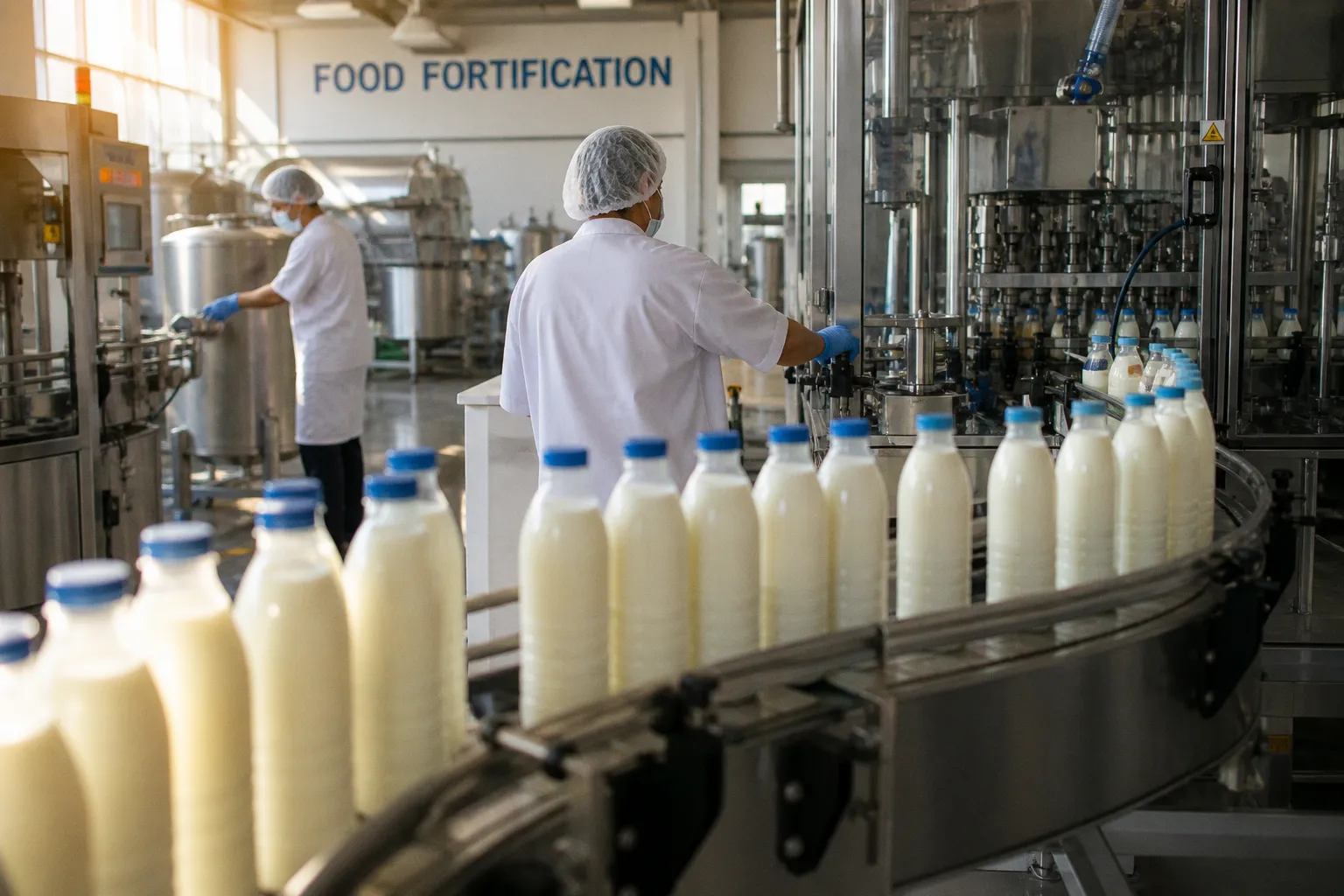
The Milken Institute has scheduled a panel under the title "Trends, Tech, and Truth: Food at the Crossroads of Health and Wealth." According to the program's listing, the session targets the operational intersection where public health priorities meet industrial food manufacturing. For fortification specialists, the framing itself — trends, technology, verification — maps directly onto a familiar constraint set: market momentum, processing limits, and bioavailability yield at scale.
The Processing Constraint at the Center
Vitamin D fortification is bounded by three processing variables: thermal degradation rate during extrusion, oxidative loss across shelf life, and the bioavailability yield of the finished matrix. The Milken listing does not enumerate specific degradation percentages; it confirms only that the panel treats food and health as a single industrial problem. That framing aligns with ongoing pressure on formulation chemists to stabilize fat-soluble vitamins in carriers that survive high-temperature short-time processing and subsequent distribution. Degradation kinetics, not label claims, determine the actual delivered dose.
Adjacent Market Signals Confirm the Pressure
Three concurrent industry reports frame the demand side of the same problem. Phytonutrient ingredient demand is accelerating on plant-based label trends, according to openPR.com. The postbiotic ingredient segment carries a reported market trajectory toward $2.02 billion by 2030 (Yahoo Finance UK), driven by preventive health positioning. BusinessLine, citing the All India Food Processors' Association, frames export-led expansion as the structural response across the broader food ingredients sector. Each data point touches the same operational variable: shelf-stable bioactivity delivered through industrial throughput. Capital is following functional ingredients, and fortification competes inside that same pipeline.
Cost-Benefit Summary for Fortification Programs
For researchers and policymakers tracking the event, two verifications are actionable. First, identify which ingredient categories — postbiotics, phytonutrients, fat-soluble vitamins — receive the next allocation of capital and regulatory bandwidth; upstream R&D investment follows that signaling. Second, document encapsulation matrix compatibility before retrofitting any existing fortification line. The gap between bench-top bioavailability data and factory-floor yield remains the dominant cost driver in vitamin D delivery, and it is rarely closed without line-specific reformulation work. The Milken panel's confirmed participants, specific policy outputs, and technical commitments are not detailed in the available source material and should not be assumed.