New EU Strategy for Agri-Food Innovation: Scaling Vitamin D Fortification Technologies
The European Commission has put forward a strategy targeting agri-food innovation and nutrient-dense processing technologies across member states, according to a Commission communication.
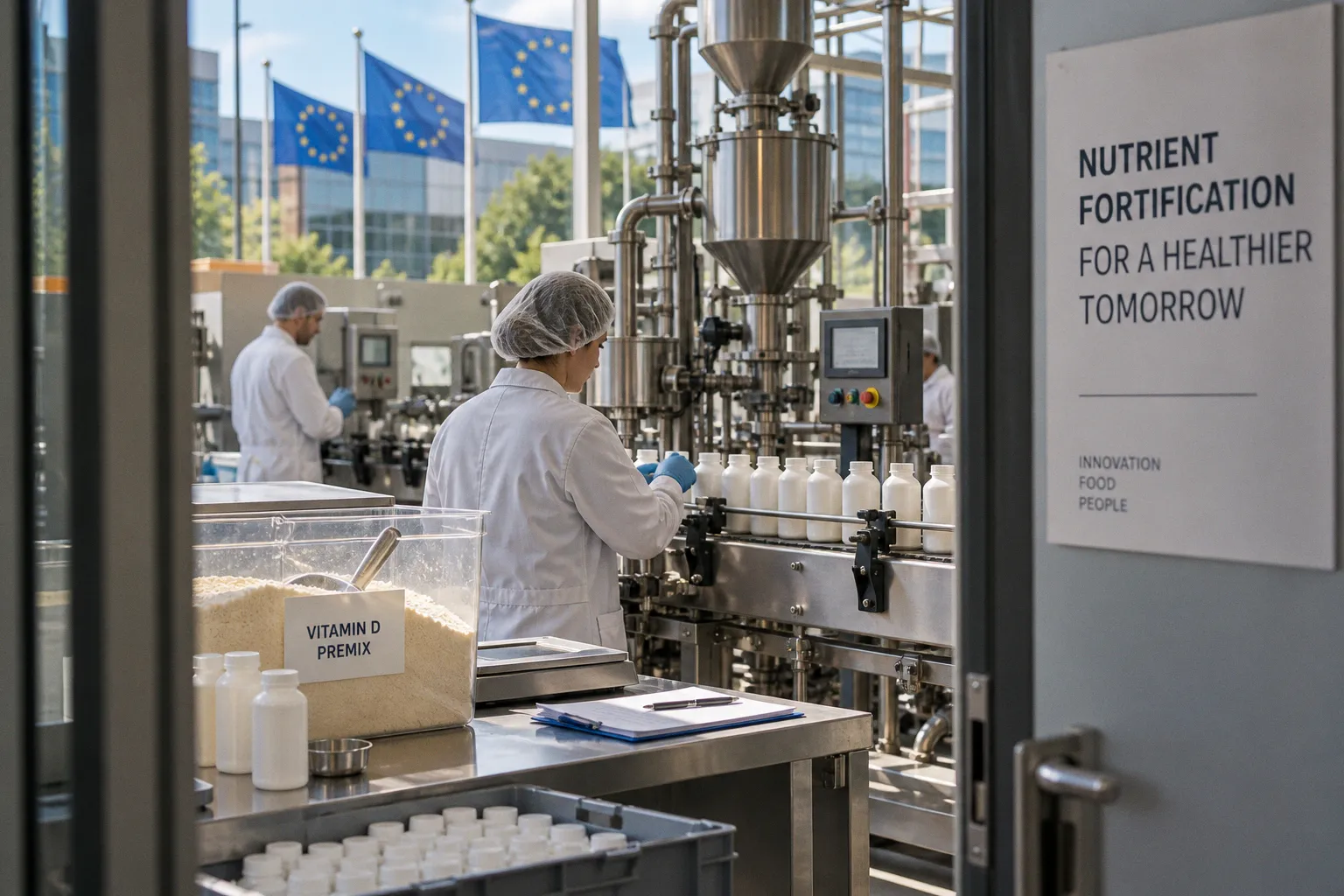
Direct relevance to fortification lines: process selection, matrix stability, and scale-up economics for fat-soluble micronutrients.
Process constraints on the table
Vitamin D stability is governed by the host matrix. In lipid-based carriers, oxidative degradation accelerates above 60 °C and under high shear. In dry blends, segregation kinetics depend on particle density matching and electrostatic behavior. Any EU strategy that funds "nutrient-dense processing" must be read against these mechanical realities — extrusion, spray drying, and encapsulation each carry distinct bioavailability yields and distinct loss profiles.
The Commission framing, as reported, groups these under a single "innovation" banner. From a factory-floor standpoint, the operative question is which unit operations receive harmonized support and which remain dependent on national pilot funding.
Cross-reading from the field
Spanish minister Luis Planas, cited in coverage from Demócrata, framed science as the driver of agri-food innovation — a policy signal aligning with EC messaging. Separately, Pack Expo programming reported by The National Provisioner indicates where processing technology vendors will physically demonstrate solutions for industry pain points. Convergence on the same theme: deployment velocity, not discovery, is the bottleneck.
What to track in the fortification stack
Three operational checkpoints follow from this announcement:
1. Funding windows for D2/D3 encapsulation R&D — whether matrix encapsulation and microemulsion formats qualify under the Commission's nutrient-dense processing scope.
2. Regulatory harmonization on voluntary versus mandatory fortification thresholds, and the impact on minimum fortificant load across dairy, plant-based beverages, and flour carriers.
3. Scale-up pathways — pilot lines to commercial throughput — including validated extrusion retention rates for cholecalciferol in cereal matrices.
No timeline, budget figure, or named beneficiary has been disclosed in the materials available. Treat any downstream claim about specific grant totals or rollout dates as unverified until the Commission publishes the implementing text. The strategic posture is confirmed; the processing parameters are not.