Dry blending vs wet mixing for vitamin D milk powder
When vitamin D is added to milk powder, the central question is not simply how quickly the premix can enter the production line.
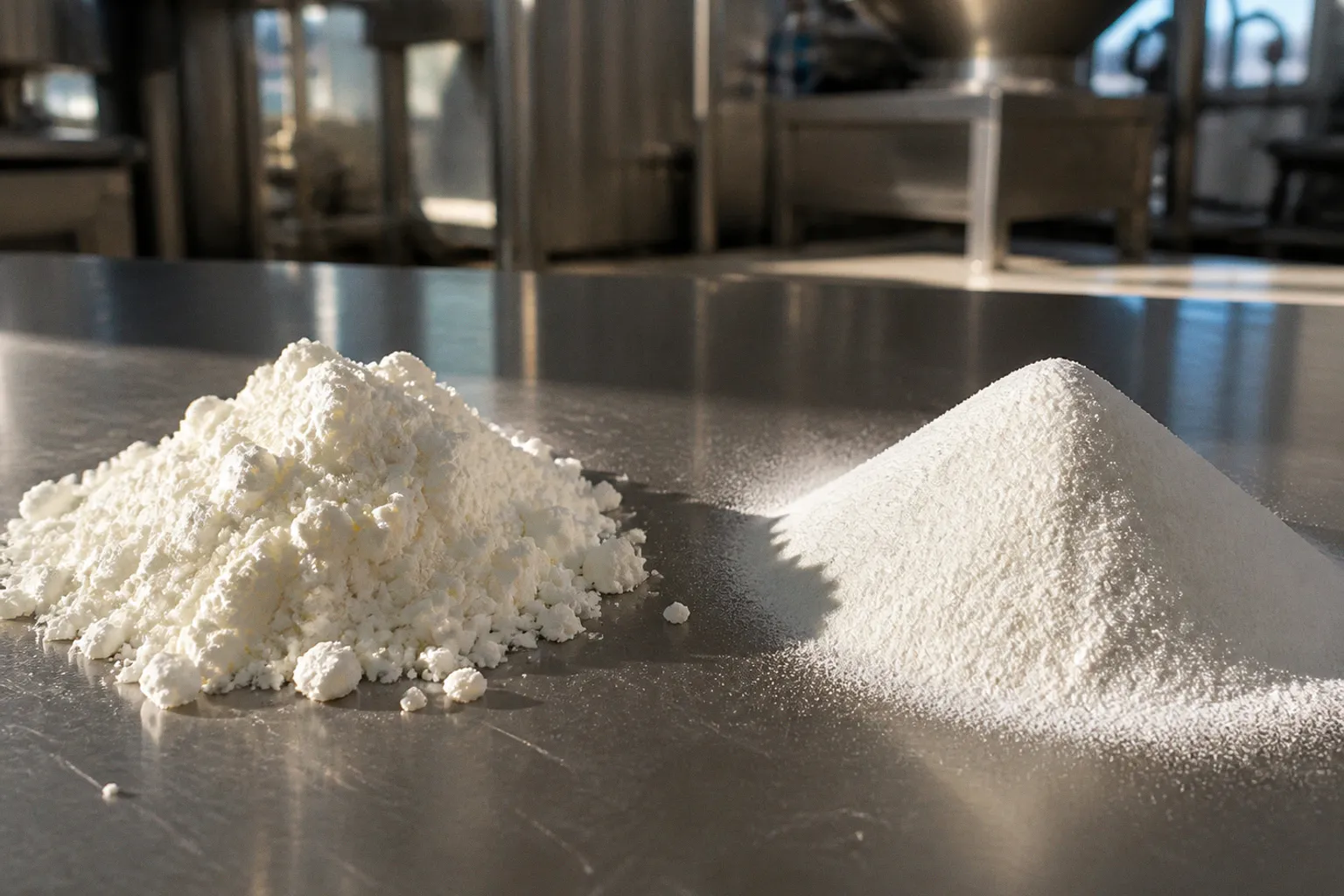
It is whether the finished product will contain the nutrient consistently, remain within specification through processing and storage, and deliver a reliable amount when the powder reaches households, school-feeding programs, clinics, or emergency nutrition systems.
That distinction matters because vitamin D fortification can fail without producing an obvious visual warning. A powder may look uniform while micronutrients have separated during blending, transport, or storage. Conversely, a process that exposes the product to liquid handling and spray drying may appear more demanding, yet create a more even nutrient distribution and a stronger basis for nutritional equity. In our work across food-fortification systems, this is where the technical decision becomes a public-health decision: a small process weakness at the plant can become an uneven dose across an entire population.
The comparison between dry blending and wet mixing for vitamin D milk powder therefore comes down to more than capital cost or thermal exposure. It is a comparison between two different ways of controlling dispersion, stability, verification, and risk.
The first divide: where the vitamin D enters the process
Wet mixing incorporates the vitamin D premix into a liquid milk phase before pasteurization, homogenization, and spray drying. Dry blending adds the premix to milk powder after the powder has already been produced, usually during a separate blending stage.
That difference determines the physical environment in which the nutrient must distribute itself.
In a wet process, the vitamin D-containing material is dispersed through a liquid system. The surrounding milk phase gives the nutrient a medium in which it can spread before the product is converted back into powder. The aim is not merely to make the premix disappear visually; it is to achieve a sufficiently even distribution throughout the feed so that the final powder does not contain nutrient-rich and nutrient-poor zones.
Wet mixing commonly maintains total solids at approximately 20%–30% in the liquid blend before pasteurization and homogenization. This range helps prevent the mixture from becoming excessively viscous, which would make pumping, heat transfer, and mechanical processing more difficult. The premix may first be dispersed in a separate milk tank heated to approximately 40–45°C, allowing the powder to dissolve or disperse more readily before it is introduced into the bulk milk stream.
Dry blending works under a different set of constraints. The milk powder and vitamin D premix are both handled as particles, and the success of the process depends on particle size, density, surface properties, flow behavior, residence time, and the geometry of the blender. Even when the initial blend appears well mixed, the material may later separate as it moves through conveying equipment, fills bags, travels by truck, or remains in storage.
This is the critical distinction: wet mixing uses a liquid phase to support dispersion before drying, while dry blending must maintain an even distribution among particles throughout the entire post-drying supply chain.
The fortification method is not finished when the vitamin D enters the mixer; it is finished when the same product still carries a dependable nutrient concentration at the point of use.
Homogeneity is the practical dividing line
For industrial milk powder fortification, homogeneity is not an abstract laboratory ideal. It determines whether a serving taken from the top of a bag, the middle of a drum, or the end of a production lot is reasonably representative of the product specification.
Wet mixing has an important advantage here because the vitamin D is distributed in the liquid phase before spray drying. This reduces the physical opportunity for the nutrient to remain concentrated in isolated premix particles. When the liquid feed is properly prepared and the process is controlled, the resulting powder is produced from a more uniform starting mixture.
The available evidence indicates that wet blending can reduce the risk of nutrient levels falling below 80% of the label claim compared with dry blending. That threshold is not a license to treat label compliance as a single pass-or-fail number; it is a reminder that the lower tail of the distribution matters. Average results can look acceptable while individual samples, sublots, or portions of a package contain less vitamin D than intended.
Dry blending is more vulnerable to what is known as segregation or stratification. Lactose, milk fat, milk powder particles, and micronutrient premix particles may not behave as one material during handling. Differences in particle size and density can cause components to migrate or settle differently. Vibration during transportation, repeated movement through hoppers, and even the way a bag is filled can alter the distribution achieved in the blender.
For a dry process to perform reliably, the premix cannot be treated as a generic powder. Its physical design becomes part of the fortification strategy. The premix may need particle characteristics that are compatible with the milk powder, an appropriate carrier, and a mixing sequence that limits local over-concentration. The blending equipment must also be operated in a way that avoids both under-mixing and excessive mechanical handling that can encourage separation after mixing.
A useful way to frame the comparison is to separate three moments that are often collapsed into one:
1. Initial mixing: whether the vitamin D premix is distributed through the milk powder or liquid milk phase.
2. Process transfer: whether pumping, drying, conveying, and filling preserve that distribution.
3. Storage and transport: whether vibration, settling, and repeated handling create new concentration differences.
Wet mixing has the stronger starting position because it creates dispersion before drying. Dry blending has to defend uniformity after the powder already exists, and that defense must continue beyond the factory floor.
Thermal processing: what actually threatens vitamin D
Thermal exposure is often presented as the main argument against wet mixing. The concern is understandable: wet mixing places vitamin D in the process before pasteurization and spray drying, while dry blending introduces it after the principal heat treatments have been completed.
But the comparison becomes misleading when all heat is treated as equally destructive.
Standard pasteurization at approximately 72°C for 15 seconds has been associated with statistically insignificant losses of added vitamin D. In other words, ordinary pasteurization under these conditions is not the primary failure point for vitamin D retention. The presence of a heat step does not, by itself, demonstrate that the fortificant has been substantially damaged.
Some wet-mix applications, including infant-formula processing, use conditions around 75°C to 100°C for 18 seconds before homogenization and spray drying. Those parameters still require process validation, because the full thermal history includes more than a single temperature-time pair. Feed composition, oxygen exposure, equipment configuration, drying conditions, and subsequent storage can all shape the final result.
At the same time, we should not make the opposite mistake and describe wet mixing as thermally risk-free. Spray drying remains a demanding operation, and vitamin D stability during commercial drying cannot be reduced to the pasteurization step alone. Exact comparative degradation rates across different inlet and outlet temperatures, particularly when weighed against long-term ambient storage in dry-blended products, are not universal. They depend on the formulation and plant conditions.
This is why the correct operational question is not whether vitamin D encounters heat. It is whether the entire process has been designed and verified around the nutrient’s actual stability profile.
| Process factor | Wet mixing | Dry blending |
|---|---|---|
| Point of vitamin D addition | Before pasteurization, homogenization, and spray drying | After milk powder production |
| Main uniformity mechanism | Dispersion through a liquid milk phase before drying | Physical mixing of vitamin-containing particles with finished powder |
| Main homogeneity advantage | Lower risk of isolated nutrient-rich or nutrient-poor regions when the liquid feed is controlled | Avoids exposing the added premix to the main thermal process |
| Main technical vulnerability | Spray-drying and thermal-process control remain necessary | Particle segregation during storage, transport, conveying, and filling |
| Typical preparation detail | Premix may be pre-dispersed at 40–45°C; liquid total solids commonly maintained at 20%–30% | Requires compatible particle properties, carrier design, and controlled blending |
| Quality concern | Retention after the complete wet process | Uneven distribution despite acceptable average batch results |
| Energy and handling profile | More liquid processing and drying demand | Lower additional thermal exposure and potentially lower energy burden |
| Packaging requirement | Strong protection from light remains necessary | Strong protection from light remains necessary |
The table points to a conclusion that is easy to miss in a simple wet-versus-dry debate: the two methods exchange risks rather than eliminating them. Wet mixing shifts attention toward thermal history, feed preparation, and spray drying. Dry blending shifts attention toward particle engineering, segregation, and post-blend handling.
Why dry blending can look efficient—and still become fragile
Dry blending is attractive because it can be added to an existing milk-powder operation without sending the fortified material through another liquid-phase process. The vitamin D premix is introduced after drying, so the added nutrient avoids the primary thermal history of pasteurization and spray drying. This can reduce thermal exposure and additional energy requirements, and it may simplify production when a plant already has a suitable powder-blending line.
For programs working with several fortification targets or multiple product variants, dry blending can also offer operational flexibility. A base milk powder may be produced first and fortified later according to market, contract, or public-health requirements. That separation can be useful when the production network is geographically distributed or when smaller lots need to be prepared without changing the entire upstream process.
Yet this flexibility can become a systemic barrier when the powder system is treated as physically neutral. It is not neutral. Finished milk powder is a population of particles with different behaviors, and the micronutrient premix often represents only a small fraction of the total mass. The smaller the fortificant fraction and the greater the mismatch between the premix and the carrier powder, the more carefully the process must be designed.
Segregation may occur because of:
- Differences in particle size between the vitamin premix and the milk powder.
- Differences in density that encourage heavier or lighter particles to migrate.
- Vibration during transport, which can reorganize the powder bed.
- Pneumatic or mechanical conveying that changes particle trajectories.
- Hopper discharge patterns that draw material unevenly from the blend.
- Extended storage, during which settling and stratification may become more pronounced.
- Filling practices that separate early and late portions of the same batch.
These are not merely engineering details. If a fortified milk powder is intended for a national nutrition program, a school-feeding network, or communities with limited access to dietary alternatives, uneven distribution can translate into uneven protection against vitamin D insufficiency. Nutritional equity depends not only on whether a fortified product exists, but also on whether its nutrient content is dependable from one portion to the next.
The plant therefore needs to test more than the composite batch average. Sampling plans must be capable of detecting distribution problems across the blender, the production run, and the package. The precise sampling design will depend on the product and regulatory framework, but the principle is straightforward: a single well-mixed laboratory sample cannot prove that a powder remained homogeneous during subsequent handling.
Wet mixing is not automatically the superior choice
The stronger homogeneity profile of wet mixing does not mean every plant should convert immediately to a liquid-phase process. Industrial decisions are shaped by equipment, product architecture, scale, water handling, drying capacity, microbiological controls, and the intended distribution route.
Wet mixing adds complexity before the powder is formed. The premix must be prepared correctly, incorporated into the liquid milk phase, and kept within a workable solids range. A mixture with total solids around 20%–30% is easier to manage than a highly viscous feed, but that operating window must be integrated with the rest of the plant’s formulation and throughput requirements.
The process also demands disciplined control of:
- Premix dispersion before bulk addition.
- Tank temperature during pre-dissolution.
- Mixing time and agitation intensity.
- Total solids and viscosity of the liquid feed.
- Pasteurization temperature and holding time.
- Homogenization performance.
- Spray-dryer operating conditions.
- Moisture control and powder collection.
- Sampling after drying and during packaging.
In other words, wet mixing improves the physical route to homogeneity, but it does not remove the need for process control. A poorly prepared liquid feed can still create variability. A spray dryer operating outside its validated range can still affect product quality. And an apparently uniform powder can still lose vitamin D later if packaging permits excessive light exposure.
For some facilities, the most sensible approach may be to use wet mixing for products where high uniformity and population-level reliability are the overriding priorities, while reserving dry blending for carefully engineered products with robust powder-flow behavior and strong post-blend verification. The decision should follow the product and the public-health objective, not a general preference for one technology.
Premix preparation: a small step with large consequences
The pre-dispersion stage deserves more attention than it often receives. When a dry vitamin D premix is intended for addition to liquid milk, it may be dispersed in a separate milk tank heated to approximately 40–45°C. This moderate warming supports dissolution and dispersion before the premix enters the larger milk volume.
The purpose is practical. Adding a concentrated powder directly into a large tank can create localized clumps or zones of high concentration, particularly if the powder wets slowly or if the addition point does not receive adequate agitation. A pre-blend creates a controlled intermediate phase, giving operators a better opportunity to observe dispersion and reduce the chance that undissolved material will remain isolated.
This step should not be confused with the final homogenization of the product. Pre-dispersion is about preparing the fortificant for even incorporation; homogenization and the broader liquid process then help maintain a consistent feed before drying.
The same logic applies to dry blending, although the tools differ. Here, the premix needs to be physically compatible with the milk powder, and the blending sequence should reduce the possibility that a very small quantity of micronutrient material will remain concentrated in one part of the equipment. Dilution with a suitable carrier may be necessary, but the carrier cannot be selected only for convenience. Its particle size, density, flowability, and behavior during storage must fit the finished product.
In both systems, the premix is not a minor accessory. It is the point where formulation science meets factory physics.
A fortificant can be chemically stable and still fail nutritionally if the process cannot keep it evenly distributed.
Light protection is non-negotiable in both systems
The wet-versus-dry decision sometimes absorbs so much attention that packaging becomes an afterthought. That is a mistake. Vitamin D is highly sensitive to light, and it can degrade rapidly when stored in clear containers exposed to illumination.
This vulnerability exists regardless of whether the nutrient was added during wet mixing or dry blending. A highly homogeneous powder will not retain its intended value if the packaging allows sustained light exposure during warehouse storage, retail display, transport, or household use.
Packaging controls should therefore be treated as part of the fortification technology, not as a separate commercial decision. The selected container or laminate needs to limit light penetration, and the protection must remain effective across the actual distribution chain. That includes secondary packaging, warehouse conditions, opening and resealing practices, and the period during which the product remains in use.
For community programs, this point is especially important because the product may travel through warm, brightly lit, or unpredictable environments before it reaches the consumer. The final nutrient dose is shaped by the entire chain:
- The fortificant’s chemical stability.
- The uniformity achieved during processing.
- The resistance of the powder to segregation.
- The conditions of transport and storage.
- The barrier properties of the package.
- The time between production and consumption.
A process comparison that considers only what happens inside the plant is incomplete. Fortification is a delivery system, and delivery continues until the powder is reconstituted or incorporated into food.
What happens after reconstitution?
The phrase “wet reconstitution vitamin D loss” can suggest that adding water to milk powder is itself a major source of vitamin D destruction. The available facts do not support such a broad conclusion. Reconstitution changes the physical form of the product, but the more consequential risks begin earlier, with instability from light, poor distribution in the powder, or inappropriate processing and storage conditions.
This distinction matters for public-health communication. Communities should not be asked to navigate unnecessary warnings that imply ordinary preparation makes fortified milk unreliable. The more useful message is that the fortification system must be designed so that the powder carries vitamin D consistently and remains protected until use.
Once the powder is reconstituted, exposure to light, air, heat, and time may still influence nutrient stability, depending on the formulation and handling conditions. But those effects should be measured in the specific product rather than assumed from the fact that water has been added. A responsible validation program follows the product through realistic preparation and use conditions, especially when fortified milk powder is distributed in settings where refrigeration, rapid consumption, or controlled storage cannot be guaranteed.
Choosing between the two routes
The decision between dry blending and wet mixing should be made through a risk map that includes technical performance and community consequences. Several questions help clarify the route:
1. Is the plant equipped to prepare and control a liquid fortified feed?
Wet mixing requires tanks, agitation, temperature control, pasteurization, homogenization, and spray-drying capacity that can operate within a validated process window.
2. Can the dry-blending line preserve uniformity after the mixer?
The blender may achieve good initial mixing, but conveying, hopper discharge, filling, and transport must also be assessed for segregation.
3. What is the product’s distribution environment?
A powder moving through long transport routes and variable storage conditions needs stronger controls than a product consumed shortly after manufacture.
4. How will compliance be demonstrated?
Composite testing alone may hide localized under-fortification. The sampling strategy must reflect the physical risks of the selected process.
5. Is light protection built into the package from the beginning?
Neither process compensates for transparent or inadequate packaging.
6. Which failure is easier for the plant to detect and correct?
Wet-process deviations may be visible through feed viscosity, tank dispersion, and process records. Dry-blend deviations may remain hidden until distributional testing reveals stratification.
7. Who depends most heavily on the product?
When fortified milk powder is a central source of vitamin D for children, institutional feeding programs, or populations facing systemic barriers to dietary diversity, the tolerance for uneven delivery should be lower.
The right route is not necessarily the one with fewer unit operations. It is the one that gives the manufacturer the strongest control over the complete path from premix to consumer.
From plant optimization to nutritional equity
At the national level, the choice between wet mixing and dry blending can influence whether a fortification program is trusted. A product that consistently meets its nutrient target supports clinicians, procurement agencies, food manufacturers, and families who rely on it. A product with unexplained variability creates uncertainty that is difficult to resolve once it has spread across multiple production sites and distribution channels.
Wet mixing generally offers a stronger foundation for homogeneity because the vitamin D enters a liquid phase before drying. It also introduces greater dependence on controlled thermal processing and spray-drying conditions. Dry blending can reduce additional thermal exposure and may offer operational flexibility, but it carries a physical vulnerability to segregation that must be addressed through premix design, equipment selection, handling controls, and representative testing.
Neither method should be promoted as a universal answer. The central task is to match the fortification technology to the plant’s capabilities and the population’s needs, then verify the result under real production and distribution conditions.
For researchers and policymakers, that means moving beyond a narrow question of whether vitamin D was added. We should ask whether it was dispersed, whether it remained stable, whether the package protected it, and whether the final product delivered a dependable amount to the people the policy was designed to reach.
For manufacturers, the actionable adjustment is equally clear: treat homogeneity, thermal history, segregation, packaging, and post-market handling as one connected control system. For public-health programs, procurement specifications should reward demonstrated distributional consistency rather than accepting an average result that conceals weak portions of a batch.
Vitamin D milk powder fortification succeeds when the technology is aligned with the delivery goal. Wet mixing is often the more defensible route where uniformity is the dominant concern and the plant can control the liquid and drying stages. Dry blending remains viable where its physical risks are engineered out rather than simply acknowledged. In both cases, the standard should be the same: a fortified product whose label is credible, whose nutrient distribution is stable, and whose protection does not depend on ideal conditions that communities may never have.