Integrating Vitamin D Fortification: From Ingredient Formulation to Final Packaging
According to FoodTechBiz, Fi India and ProPak India 2026 brought together ingredients, processing, and packaging innovation in one industry event.
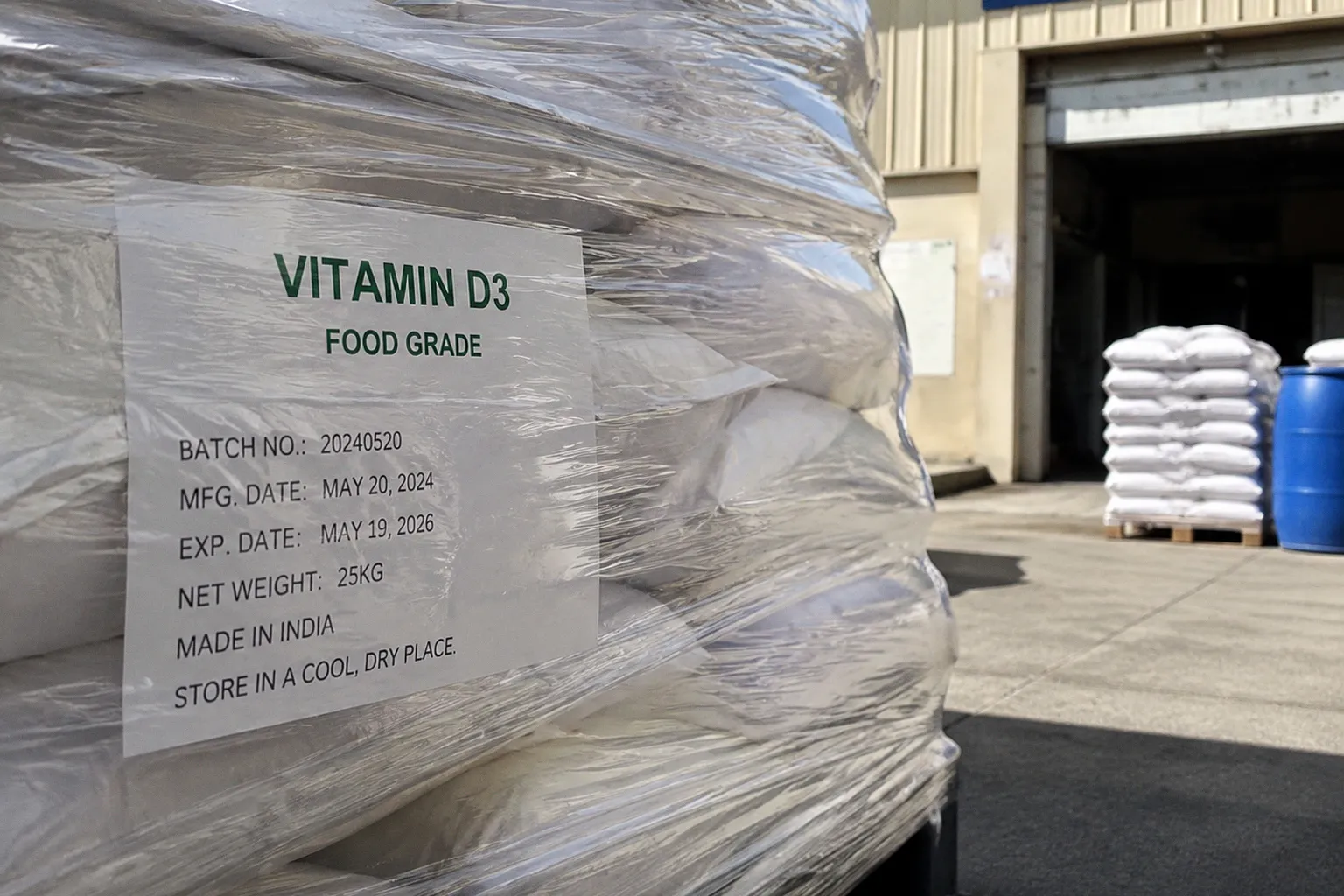
Packaging South Asia reported the same broad focus. For food-fortification professionals, the relevant point is not the exhibition label itself but the integration of three production stages that determine whether a micronutrient intervention can move from formulation to a stable, manufacturable product.
The production constraint is integration
Fortification performance is not defined by the premix alone. It depends on how an ingredient is incorporated into the food matrix, how the process affects degradation rates, and whether the final package protects the product during storage and distribution.
The available reporting identifies Fi India and ProPak India as a combined platform for ingredients, processing, and packaging. That positioning is relevant to vitamin D systems because each stage introduces a separate technical control point.
At the ingredient stage, the practical questions concern dispersion, carrier selection, dosing uniformity, and compatibility with the food matrix. At the processing stage, the critical variables are thermal load, residence time, shear, moisture, and the sequence in which the fortificant enters production. At the packaging stage, oxygen, light, moisture transmission, and seal performance become part of the stability calculation.
The reports do not provide technical data on vitamin D formulations, retention, encapsulation systems, or bioavailability yield. Those parameters should therefore not be inferred from the event description.
What the event format makes visible
A separated procurement model can conceal interactions between formulation and equipment. An ingredient supplier may demonstrate a technically suitable fortificant, while a processor must still verify dosing accuracy and matrix distribution under actual line conditions. Packaging then determines whether the retained concentration at filling remains available at the point of consumption.
A combined ingredients-processing-packaging event creates a route for evaluating these interfaces in one place. That does not establish that a specific solution performs adequately. It does, however, identify the correct sequence for technical due diligence:
1. Define the target food matrix and the required fortification point.
2. Check whether the ingredient system is compatible with the process conditions.
3. Measure uniformity and retention after processing, rather than relying on the input dose.
4. Assess the package as part of the stability system.
5. Confirm the finished-product specification through validated analytical testing.
This sequence is more useful than treating fortification as a single additive-selection decision. Vitamin D is particularly sensitive to formulation architecture because the commercial objective is not simply to add material. It is to deliver a controlled amount through a heterogeneous food system while limiting degradation and maintaining batch consistency.
What to verify before acting
The current source material supports the event’s industrial scope, but not a performance claim. Companies evaluating technologies presented under the Fi India or ProPak India umbrella should request product-specific evidence rather than extrapolating from exhibition positioning.
The minimum technical file should distinguish between input concentration and measured finished-product content. It should also state the relevant processing conditions, packaging configuration, sampling plan, analytical method, and storage interval used for any retention result. Without these details, comparisons between matrix encapsulation systems, carriers, or packaging formats remain incomplete.
For policy and program teams, the cost-benefit calculation is equally strict. Integration can reduce coordination friction between suppliers and manufacturers, but it does not remove validation costs. The benefit is a potentially clearer path from ingredient selection to packaged product. The cost is the additional verification required at every transfer point in the process.
Fi India and ProPak India 2026 therefore matter as a map of the supply chain, not as evidence that any particular fortification technology has achieved a defined stability or bioavailability result.