Mushroom biofortification: a roadmap to vitamin D enrichment
UV light mushroom biofortification is controlled by geometry before it is controlled by dose. In whole mushrooms, ultraviolet exposure reaches mainly the outer surface.
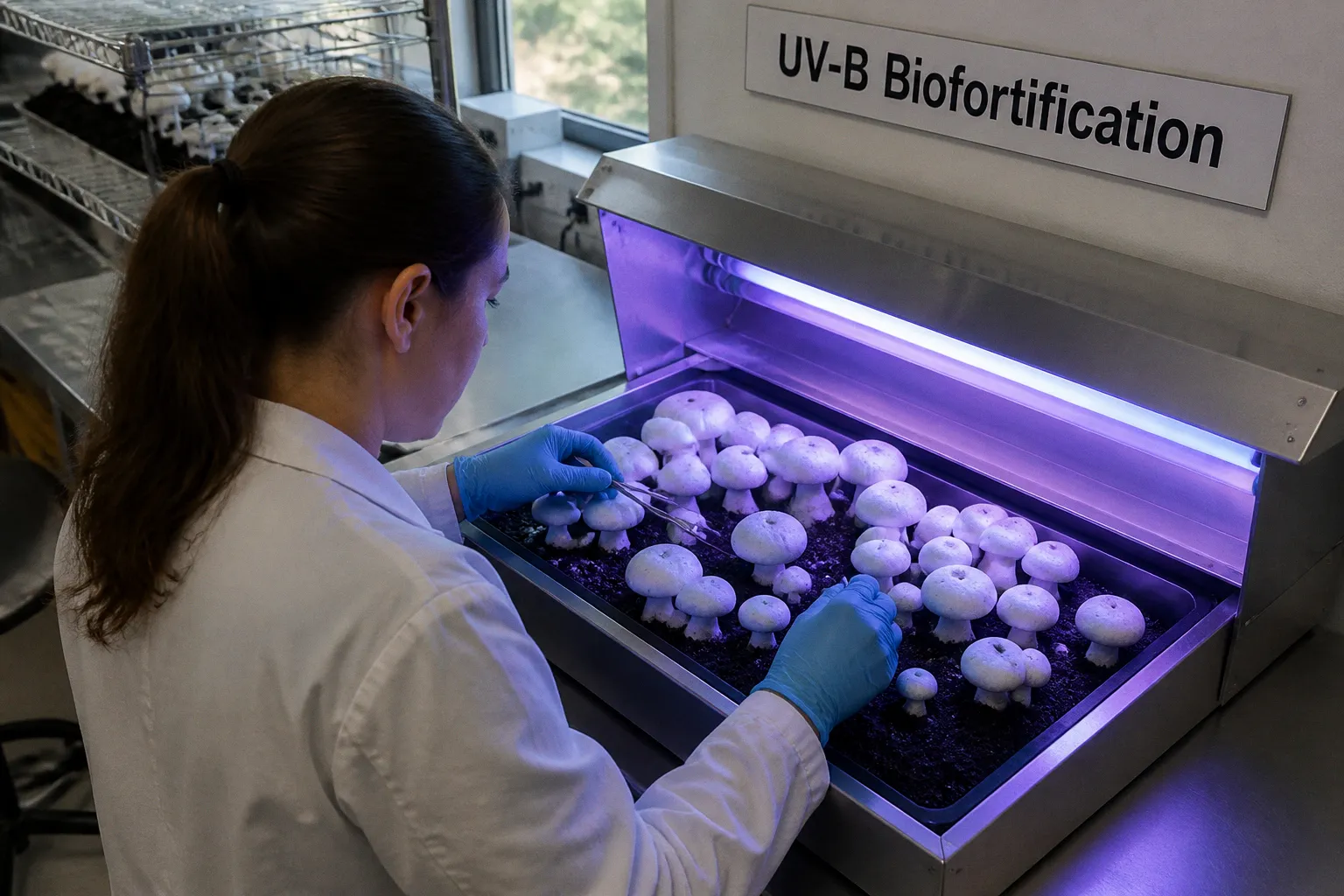
Vitamin D2 formation is therefore concentrated within approximately the first 1 mm of tissue. Increasing irradiation time does not compensate for poor surface access. It increases the risk of reaching a photochemical plateau, followed by nutrient degradation, discoloration, or oxidative damage.
The process is not conventional fortification. No vitamin D2 is added as an external ingredient. Ultraviolet radiation converts a native mushroom sterol, ergosterol, into pre-vitamin D2 and then ergocalciferol, the compound commonly designated as vitamin D2. The production objective is not maximum UV exposure. It is a reproducible vitamin D2 yield after irradiation, handling, storage, and thermal processing.
Photoconversion mechanics: from ergosterol to ergocalciferol
Mushrooms grown in dark conditions contain ergosterol in their cellular membranes. Ergosterol functions as the precursor for photochemical vitamin D2 synthesis. When it absorbs ultraviolet radiation, the sterol structure undergoes a molecular rearrangement.
The sequence is operationally simple but sensitive to process conditions:
1. UV absorption begins in the ergosterol-containing tissue. Ergosterol absorbs radiation across approximately 240–320 nm, with UV-B wavelengths being the relevant industrial treatment range.
2. The precursor forms pre-vitamin D2. This intermediate is produced through a photochemical ring-opening reaction.
3. Thermal isomerization follows. Pre-vitamin D2 converts into ergocalciferol.
4. Further exposure becomes inefficient. Once available ergosterol near the exposed surface has been converted, additional radiation contributes less to vitamin D2 accumulation.
5. Excessive exposure can reduce product quality. The system may enter a plateau or degradation phase rather than continuing to produce higher vitamin D2 concentrations.
For practical processing, the relevant UV-B range is approximately 290–320 nm. The broader absorption band explains why ergosterol can respond to different ultraviolet sources, but it does not establish one universal lamp specification or treatment schedule. Lamp spectrum, irradiance, distance, product orientation, moisture content, surface condition, and residence time all affect the delivered dose.
The product is vitamin D2, not vitamin D3. Mushrooms exposed to UV-B synthesize ergocalciferol from ergosterol. They do not generate cholecalciferol through the same pathway used in human skin.
This distinction affects labeling, analytical methods, and nutritional interpretation. A formulation or regulatory document that treats UV-treated mushrooms as a source of vitamin D3 is chemically incorrect.
The limiting variable is usually exposed ergosterol, not the nominal power of the UV lamp.
Surface area is the primary process lever
Whole mushroom fruit bodies are poor geometric substrates for rapid and uniform UV treatment. Their curved surfaces create uneven irradiance. Some regions face the lamp directly. Others receive oblique exposure or remain partially shadowed. Internal tissue receives little useful radiation because UV penetration is shallow.
In fresh whole mushrooms, photoconversion occurs primarily within approximately 1 mm of the directly exposed outer surface. The interior is not a secondary reservoir that can be efficiently activated by increasing the treatment duration. It is largely outside the effective optical path.
Slicing changes the mass-transfer and irradiation geometry. It exposes additional tissue surfaces and reduces the distance between the light source and the ergosterol-containing material. Research data report vitamin D2 concentrations of up to 406 µg/g dry matter in sliced mushrooms, compared with approximately 45 µg/g dry matter in whole fruit bodies under the reported treatment conditions. The difference is not a small optimization effect. It demonstrates that surface preparation can dominate the final enrichment result.
A sliced product also presents new control problems:
- Slice thickness determines the proportion of material located within the effective irradiation depth.
- Slice orientation controls direct exposure and shadowing.
- Surface moisture changes reflectance and can alter the delivered dose.
- Overlapping slices create unexposed contact zones.
- Mechanical handling can introduce variation in residence time and bed depth.
- Drying before or after irradiation changes both sterol concentration and the physical response of the matrix.
For a production line, the target is not simply a high surface-area-to-mass ratio. The target is a stable and measurable exposure distribution across the entire batch.
Whole mushrooms versus sliced material
| Process parameter | Whole fruit bodies | Sliced mushrooms |
|---|---|---|
| Effective exposed area | Limited by curved external surface | Increased substantially by cut faces |
| UV penetration relevance | Conversion concentrated near the outer surface | More tissue can be positioned within the effective depth |
| Dose uniformity | Affected by shape, orientation, and shadowing | Improved if slices are dispersed in a controlled layer |
| Reported vitamin D2 yield | Approximately 45 µg/g dry matter under reported conditions | Up to 406 µg/g dry matter under reported conditions |
| Main process risk | Underexposure of shaded or distant surfaces | Overlapping, uneven bed depth, and variable moisture |
| Industrial implication | Requires strict orientation and handling control | More compatible with continuous spreading and controlled irradiation |
These values should not be treated as universal specifications. Mushroom species, developmental stage, pre-treatment, dry matter content, and analytical method can shift the result. They are useful because they quantify the effect of geometry, not because they define a single commercial recipe.
Designing the UV irradiation process
An industrial mushroom vitamin D enrichment line must control dose at the product surface. Lamp rating alone is not a process parameter. The relevant variable is the energy received by the product over a defined wavelength range.
A basic dose relationship is:
UV dose = irradiance × exposure time
In practice, the relationship becomes more complex because irradiance is not uniform across the treatment zone. Distance from the lamp, reflector design, lamp aging, conveyor speed, product loading, and air movement can all change the effective dose.
Reported UV-B dose examples for enhanced ergocalciferol accumulation range from approximately 25 kJ/m² to 75 kJ/m². This is a process-development range, not a universal operating window. The correct setting must be established for the specific mushroom species, format, moisture state, and equipment configuration.
A controlled process sequence
1. Define the food vehicle
The first decision is whether the enriched material will be sold as fresh mushrooms, a dried ingredient, a powder, or an intermediate for a formulated food. The intended vehicle determines the acceptable moisture content, treatment order, packaging requirements, and analytical endpoint.
Fresh whole mushrooms may preserve their original appearance but present greater irradiation variability. Sliced or dried material is easier to distribute as a shallow layer and can produce higher vitamin D2 concentration per unit of dry matter. The trade-off is additional mechanical handling and possible changes in texture, color, and oxidation behavior.
2. Characterize the starting matrix
Ergosterol content is not constant across all mushrooms. Species, cultivation conditions, growth stage, storage history, and tissue composition affect the available precursor. The baseline must be measured or otherwise characterized before treatment development.
Dry matter is particularly important when comparing batches. Vitamin D2 expressed per gram of dry matter can appear high even when the wet-basis concentration is substantially lower. Both reporting bases may be necessary when the ingredient moves between fresh and dried formulations.
3. Prepare the surface
Slicing increases exposure, but it must be standardized. Thickness, cut pattern, and loading density should be treated as controlled variables. A deep product bed can create self-shadowing. A tightly packed layer can expose only the uppermost surfaces. A thin, evenly dispersed layer improves optical access.
For continuous equipment, the product should move through the irradiation zone without excessive overlap. The treatment surface must be inspected for dead zones created by belt edges, sidewalls, transfer points, or vibration-induced accumulation.
4. Map the radiation field
Dose mapping is required across the usable treatment area. The center of the conveyor may receive a different dose from the edges. Reflectors can improve distribution but may also create localized high-intensity regions. Lamp height and product distance must be fixed during validation.
Lamp output changes over service life. A process based only on nominal lamp wattage will drift. Irradiance monitoring, lamp replacement criteria, and cleaning procedures should be defined as part of the production control system.
5. Establish the treatment window
The treatment window should be defined by vitamin D2 yield and product quality together. A higher dose is not automatically a better dose. Once the conversion curve approaches a plateau, additional exposure has diminishing nutritional value. At a higher threshold, degradation may begin to offset further synthesis.
The operating point should therefore sit below the degradation region and include a tolerance for normal equipment variation. A narrow laboratory optimum may be unsuitable for a factory process if small changes in loading or lamp intensity produce large changes in the final concentration.
6. Verify the product analytically
Vitamin D2 should be measured using a validated analytical method. The assay must distinguish ergocalciferol from related sterol compounds and account for the food matrix. Liquid chromatography-based methods are suitable for this purpose when properly validated.
Sampling is a major source of error. A surface sample from the top of a treated bed may not represent the complete batch. Sampling plans should cover different conveyor positions, product depths, and production times. The process is only standardized when the analytical result reflects the actual distribution of vitamin D2 through the lot.
Standardizing dose without creating a degradation problem
The dose-response relationship in UV light mushroom biofortification vitamin D is not indefinitely linear. Early exposure can produce a substantial increase in ergocalciferol. As available ergosterol near the surface is consumed, the rate of accumulation decreases. Continued irradiation can produce a plateau. At excessive exposure, degradation and quality deterioration become more significant.
This behavior is consistent with a constrained photochemical system. The treatment is limited by:
- The amount of ergosterol in the exposed tissue.
- The proportion of product receiving direct UV-B radiation.
- The wavelength distribution of the source.
- The ability of the matrix to dissipate heat.
- Moisture-dependent changes in optical and chemical behavior.
- The stability of vitamin D2 and related intermediates under prolonged exposure.
- Oxygen availability and the formation of oxidation products.
The plateau effect is not evidence of process failure. It is a signal that increasing dose is no longer the correct control strategy. The next adjustment should usually involve surface access, product thickness, exposure uniformity, or treatment order.
Variables that require species-specific validation
A universal UV dose cannot be applied safely across all mushroom species. The same nominal treatment may generate different vitamin D2 yields because the species differ in ergosterol content, tissue density, moisture, pigmentation, surface structure, and tolerance to drying or heating.
The following variables should be evaluated during process development:
- Species and strain.
- Whole, halved, sliced, or powdered format.
- Slice thickness and layer depth.
- Fresh versus dried condition.
- Initial and final moisture content.
- UV-B wavelength distribution.
- Irradiance at the product surface.
- Exposure time and conveyor speed.
- Product temperature during irradiation.
- Oxygen exposure and packaging delay.
- Vitamin D2 concentration immediately after treatment.
- Vitamin D2 concentration after the intended storage and cooking sequence.
The last two measurements are not interchangeable. A process can produce a high post-irradiation value and still deliver a lower nutritional contribution at the point of consumption if later processing causes losses.
Dose standardization ends at the consumer-use stage, not at the lamp housing.
Thermal stability and vitamin D2 retention
UV irradiation of mushrooms is often only one step in the food chain. The treated material may be sautéed, stir-fried, boiled, dried, baked, incorporated into a sauce, or converted into a powder. Thermal processing changes moisture, mass, surface area, and matrix structure. It can also influence the measured concentration through both true nutrient loss and concentration effects.
Reported true retention of vitamin D2 after thermal culinary cooking ranges from 53% to 89% in UV-B-irradiated mushrooms. The highest retention in the cited data was observed in stir-fried mushrooms. The range is broad enough to rule out a single generic retention factor for all cooking methods.
The distinction between concentration and retention must be maintained:
- Concentration describes the amount of vitamin D2 per unit of product after processing.
- Retention describes the proportion of the original vitamin D2 remaining after processing.
- Moisture loss can increase concentration per gram even when some vitamin D2 has been lost.
- Serving yield determines the actual nutrient delivered to the consumer.
A dried mushroom ingredient may show a higher vitamin D2 concentration than the original fresh product because water has been removed. That does not necessarily mean that vitamin D2 was created during drying or that total nutrient retention was complete.
Processing order: irradiate before or after drying?
The correct sequence depends on the product design. Drying can improve handling and make it easier to spread the material in a controlled irradiation layer. It also changes the matrix and can increase the concentration of ergosterol and vitamin D2 on a dry-matter basis. However, drying introduces thermal exposure and may affect color, texture, oxidation, and storage stability.
Irradiating fresh slices can preserve a different matrix state and may support efficient photoconversion because the cut surfaces are directly exposed. The resulting material may then require drying, milling, or packaging. Each downstream operation must be included in the mass balance.
A practical validation plan should compare at least these endpoints:
1. Vitamin D2 immediately after UV-B treatment.
2. Vitamin D2 after drying or other primary stabilization.
3. Vitamin D2 after milling and blending.
4. Vitamin D2 after defined storage.
5. Vitamin D2 after the intended culinary or formulation process.
6. Vitamin D2 per serving at the final point of consumption.
Without this sequence, the process may be optimized for a laboratory intermediate rather than for a usable food ingredient.
Matrix effects, encapsulation, and delivery performance
Mushrooms can function as the food vehicle themselves or as a source ingredient for a broader formulation. When UV-treated mushroom powder is incorporated into another food, the matrix becomes a new stability environment.
Matrix encapsulation may be relevant when vitamin D2 is transferred into a dry blend, beverage base, dairy-style product, bakery formulation, or supplement-like food. Encapsulation can reduce exposure to oxygen, light, and incompatible components. It can also improve dispersion and control the release of a lipophilic nutrient in an aqueous system.
However, encapsulation is not automatically beneficial. It introduces carrier materials, additional unit operations, and a new set of release and assay questions. The relevant endpoint is bioavailability yield, not simply the total vitamin D2 measured in the package.
For an industrial formulation, the following issues should be separated:
- Chemical stability: how much ergocalciferol remains.
- Physical stability: whether the ingredient remains dispersed and does not sediment, agglomerate, or segregate.
- Matrix compatibility: whether pH, fat content, water activity, minerals, and processing heat affect the nutrient.
- Analytical recovery: whether the assay extracts the vitamin D2 efficiently from the finished matrix.
- Bioavailability: how much of the measured nutrient becomes available after digestion and absorption.
A high laboratory assay with poor dispersion can create an uneven finished product. Some portions may contain excessive vitamin D2 while others contain less than the formulation target. Blend uniformity therefore becomes part of the fortification problem.
The mushroom route has one operational advantage: the precursor conversion occurs in the food material before formulation. This can reduce the need to add a separate purified vitamin ingredient. It does not eliminate the need for dose control, analytical verification, or stability testing.
From laboratory treatment to industrial mushroom enrichment
Scaling the UV irradiation of mushrooms process requires the conversion of a biological material into a controlled optical load. The main difficulties are physical rather than conceptual.
Mushrooms vary in size and shape. Slicing creates fragments with different exposed areas. Fresh tissue changes during storage. Water evaporates during processing. The product can stick to belts or form overlapping layers. Each condition affects irradiation uniformity.
A scalable line should include defined controls for:
Feed preparation
The incoming material must have controlled size distribution and an identified moisture range. Large variation in slice thickness or fragment size will produce different effective exposure depths. The input should be screened for damaged, heavily soiled, or excessively wet material because surface condition affects light delivery and downstream quality.
Product spreading
The irradiation layer must remain consistent. A deep or uneven bed creates shadowing. Mechanical spreaders, vibrating conveyors, or belt-speed control may be required to maintain the target loading. The exact equipment depends on whether the product is fresh slices, dried pieces, or powder.
Optical exposure
The UV source should be specified by wavelength distribution and irradiance at the product surface. Shielding and interlocks are required for worker safety. Reflectors, lamp spacing, and product distance should be treated as part of the validated equipment configuration rather than adjusted informally during production.
Thermal management
UV systems can generate heat. Product temperature should be monitored because thermal exposure may affect texture, moisture, oxidation, and vitamin D2 stability. A process that achieves the target UV dose by allowing the product to heat excessively may not be acceptable even if the final assay is initially high.
Post-treatment handling
The interval between irradiation and drying, milling, blending, or packaging can affect retention. Treated material should not be left exposed to uncontrolled light and oxygen without a defined reason. Packaging must also protect the finished ingredient from further light exposure where necessary.
Batch release
The release specification should include vitamin D2 concentration, moisture or water activity where relevant, microbiological criteria appropriate to the product, and uniformity across samples. The exact specification depends on the food category and intended use. The process cannot be judged solely by the highest analytical result observed in a single sample.
The role of mushroom biofortification in vitamin D food systems
UV-treated mushrooms are a form of biofortification because the nutrient is generated within the food matrix through conversion of a native precursor. This differs from adding crystalline vitamin D2 or D3 to a carrier after harvest. The distinction matters for process design and policy.
A biofortified mushroom ingredient can be attractive where the product already has a defined culinary or food-processing role. It may be used as a dried ingredient, powder, or component in formulated foods. The nutrient is associated with the mushroom matrix rather than being introduced as a separate premix.
The approach also has limits:
- Vitamin D2 yield depends on ergosterol availability.
- The conversion is concentrated near exposed surfaces.
- Whole mushrooms are less efficient substrates than sliced material under comparable short exposures.
- Excessive UV treatment does not provide unlimited enrichment.
- Species-specific process parameters are required.
- Downstream cooking and storage reduce the amount ultimately retained.
- Long-term storage degradation rates for commercial UV-treated powders under varying humidity conditions remain insufficiently standardized.
These constraints do not invalidate the technology. They define the route for responsible deployment. A food vehicle should be selected according to the complete chain: precursor content, processing geometry, intended serving, storage conditions, and final consumption method.
For readers working across fortification policy and nutrient delivery systems, the distinction between nutrient production and nutrient delivery is central. A high vitamin D2 concentration at the factory exit is only one part of the nutritional system. The relevant public-health endpoint is consistent delivery at the point of consumption, within an appropriate serving and regulatory framework.
A practical validation roadmap
A technically credible development program can be organized into five stages.
1. Screen the raw material. Measure baseline ergosterol and vitamin D2 in the selected mushroom species and format. Record moisture and dry-matter values.
2. Optimize the geometry. Compare whole, halved, sliced, and dried formats. Hold the UV source constant while assessing the effect of surface area, slice thickness, and product loading.
3. Map the dose response. Test a defined UV-B range, including doses around 25–75 kJ/m² where appropriate for the equipment and material. Identify the point where vitamin D2 accumulation approaches a plateau.
4. Include downstream processing. Measure retention after drying, milling, storage, formulation, and cooking. Do not use the immediate post-irradiation result as the final product specification.
5. Validate uniformity at scale. Sample across the full treatment zone and across multiple production runs. Confirm that equipment drift, product variation, and normal handling do not move the batch outside the target range.
The analytical plan should be designed with the process. Vitamin D2 extraction from mushroom tissue and formulated foods can be affected by the matrix. Method performance, sample homogenization, recovery, and detection limits should be established before comparing treatment conditions.
Cost-benefit position
The main technical benefit of UV light mushroom biofortification vitamin D is that it uses a native precursor and can produce substantial vitamin D2 enrichment without adding a separate vitamin premix during the conversion step. Slicing is a low-complexity intervention with a large effect on exposed surface area. The technology can therefore be integrated with existing cutting, drying, and powder-processing operations.
The main costs are process control and validation. UV equipment requires shielding, irradiance monitoring, cleaning, and lamp management. Product spreading must be consistent. Species and format changes require revalidation. Analytical testing is necessary because visual inspection cannot establish vitamin D2 content or uniformity. Downstream cooking and storage must be included in the nutrient mass balance.
The economic case is strongest when the product already moves through a sliced or dried format and when the treated ingredient has a defined use with predictable serving sizes. The case is weaker when whole-mushroom appearance must be preserved, when the product has highly variable geometry, or when the final food undergoes severe thermal and storage conditions without a reliable retention model.
The production rule is strict: optimize exposed matrix first, dose second, and final nutrient delivery last. UV-B irradiation can convert ergosterol into useful vitamin D2, but only a controlled process can convert that reaction into a consistent food ingredient.