Optimizing Vitamin D Fortification in Dairy: Technical Strategies and Bioavailability Outcomes
A recent review in Revista Chilena de Nutrición catalogs the technical pathways for delivering the active compound through dairy matrices, with microencapsulation and nanoemulsion formats positioned…
Production Stability Versus Bioavailability Yield in Dairy Fortification
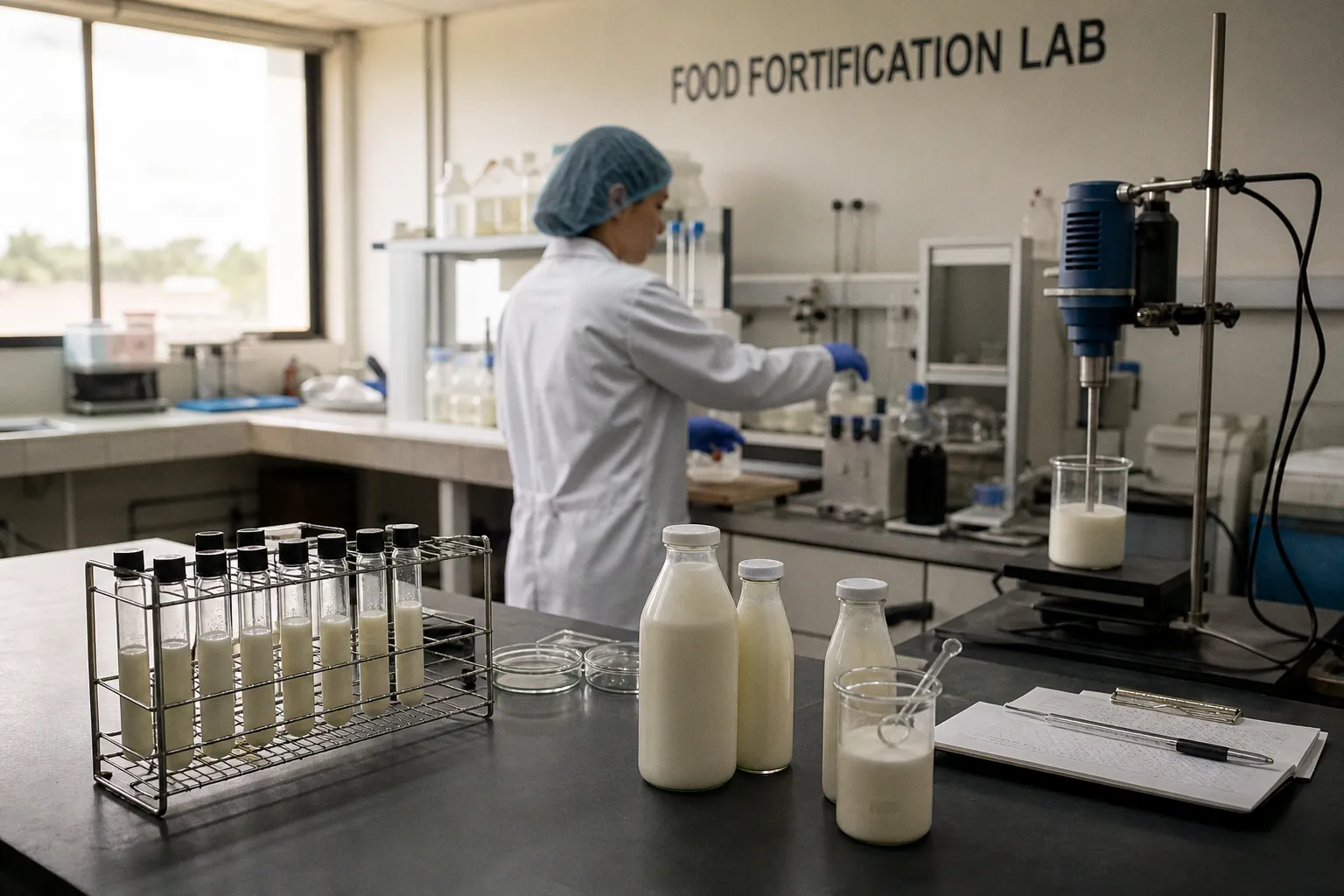
Matrix stability remains the binding constraint in any vitamin D fortification scheme. A recent review in Revista Chilena de Nutrición catalogs the technical pathways for delivering the active compound through dairy matrices, with microencapsulation and nanoemulsion formats positioned as the primary vehicles for preserving potency from processing through shelf life. For a fortificant prone to oxidative degradation under heat, light, and shear, the carrier system dictates the final bioavailability yield.
Selecting the Active Form: D3 Versus D2 on the Process Line
An ICMR-NIN study published in Molecular Nutrition and Food Research introduces a parallel constraint: the form of vitamin D selected for fortification. In male rats maintained on and recovering from deficiency, D3 raised circulating 25-hydroxyvitamin D levels approximately two-fold over D2 at equivalent doses. The differential extended to muscle fibre size, grip strength, cardiac contractility markers, and energy metabolism markers, with the gap widening during the recovery phase.
Both isoforms enter the fortification stream. D2 retains a role in markets with widespread vegetarian or vegan adherence due to its fungal and UV-irradiated yeast origin. The rat data, however, add weight to D3 selection where dietary restrictions do not dictate otherwise. The study's authors note that evidence on extra-skeletal effects between the two forms has remained limited prior to this work.
What to Track on the Factory Floor
For processors evaluating dairy fortification upgrades, three parameters demand close monitoring:
1. Carrier integrity post-extrusion or pasteurization. Microencapsulation efficiency degrades under thermal stress; loss rates must be quantified against the specific time-temperature profile of the dairy line.
2. Isoform sourcing economics. D3 supply chains draw from animal-based precursors and lanolin-derived inputs, introducing price volatility absent from D2 supply.
3. Dosage reconciliation. The two-fold 25OHD differential observed in the ICMR-NIN rat study implies that D2-fortified products may require higher nominal dosages to match D3-equivalent serum response — a cost-benefit trade-off that must be modeled before reformulation.
On a global scale, with reported population insufficiency ranging from 50% to 80%, the technical question is no longer whether to fortify but which delivery format and which isoform delivers the highest recovered potency per unit cost. The combination of carrier technology and isoform selection now defines the competitive margin in fortified dairy.