Calgary ag-tech investment aims to boost food security amid U.S. tariff uncertainty
According to CityNews Calgary, municipal officials are channeling ag-tech investment toward domestic food security as U.S. tariff policy introduces procurement volatility.
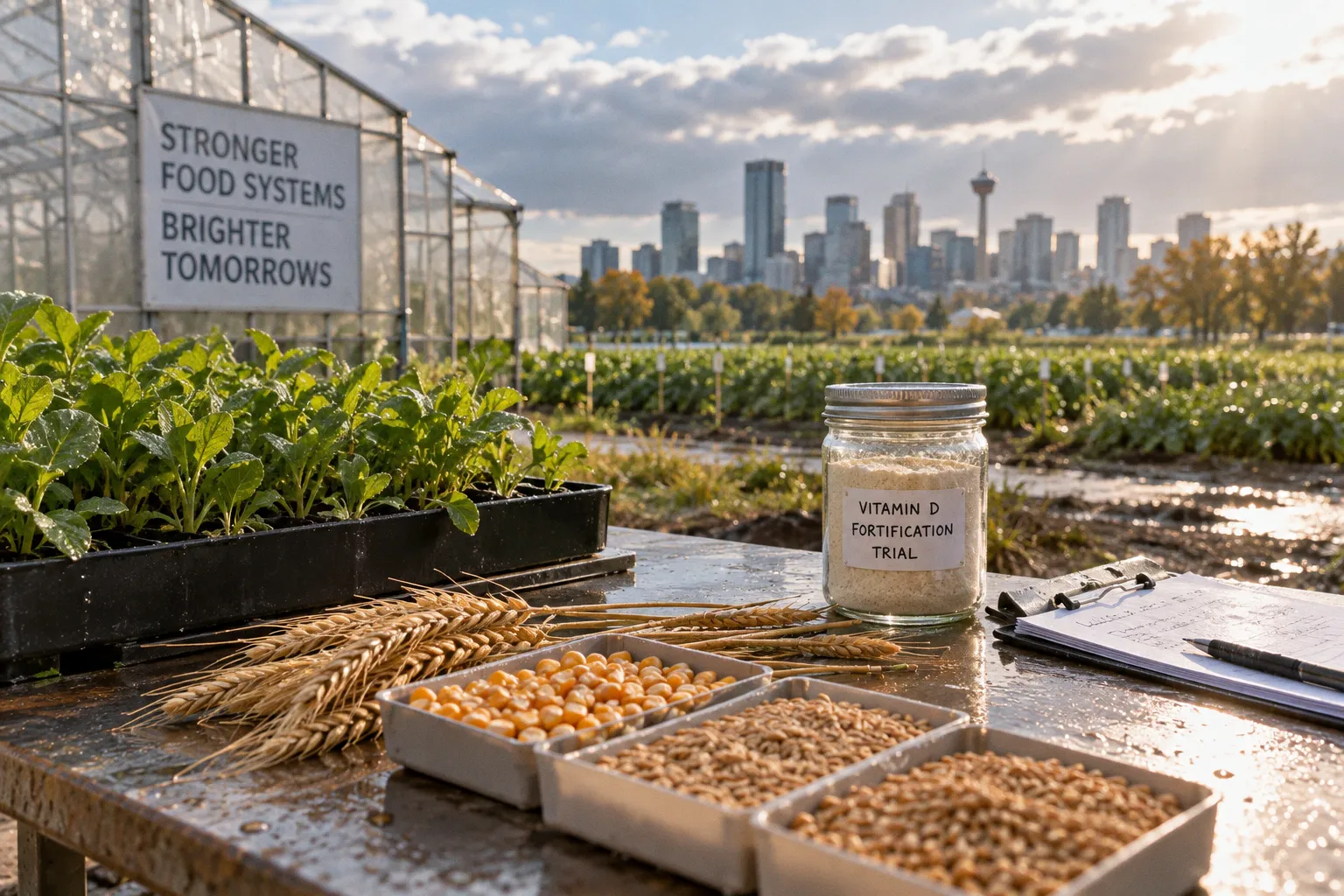
The Tariff Pressure Point
For fortified food processors, the underlying signal is a supply chain recalibration: when cross-border ingredient flows destabilize, the carriers and bioactives underpinning fortification programs become procurement risks rather than standard line items. The shift reframes fortification as a logistics problem before it becomes a formulation problem.
Process Implications for Fortification Operations
The city had previously warned that retaliatory tariffs could add $315–466 million to existing municipal contracts. Translated into a processing context, marginal cost increases on imported fortification-grade inputs force reformulation teams to revisit ingredient specifications, bioavailability yields, and degradation rates under modified storage conditions. Vitamin D fortification relies on stable supply of carrier matrices — dairy, flour, oil emulsions, and beverage bases — most of which traverse the Canada–U.S. border before final incorporation. Disruption at that interface cascades into dosing precision at the batch level.
Parallel developments reinforce the broader pivot. Plant breeders have called for expanded investment in agricultural innovations ahead of a conference scheduled in Nigeria's Federal Capital Territory, and PepsiCo has separately reported progress on its agriculture and sustainable sourcing targets. Both signal that multinational processors are repositioning around domestically anchored supply chains rather than waiting for tariff structures to stabilize.
What to Monitor on the Factory Floor
Three technical checkpoints warrant attention as the Calgary investment matures:
- Specification stability. Whether domestically scaled ag-tech output can deliver fortification-grade carriers with consistent matrix compatibility and shelf-life performance against existing Certificates of Analysis.
- Carrier bioavailability. Any reformulation away from imported carriers introduces new encapsulation challenges. Expect revised bioavailability yield targets in product specifications, and validate them through accelerated stability trials rather than historical baselines.
- Cost-pass-through thresholds. The $315–466 million tariff exposure estimate for municipal contracts provides a scale reference. Map analogous exposure across your own ingredient categories, particularly for vitamin D3 and its stabilization adjuncts.
The decisive metric remains input reliability. When tariff structures compress sourcing windows, fortification programs lose their tolerance for variability — and process engineers lose the margin for error in dosing precision.